Mechanics and Relativity
Notes from Martin McCall's Lectures
Part I
Newton's Laws of Mechanic's
-
A body remains at rest or moves with uniform velocity when no external force acts
'Law if Inertia' - Galileo: Constant velocity is the natrual state of motion
- The rate of change of momentum of a body is proportional to the force acting on the body
Most systems have constant mass (however rocket motion is one of many exceptions) in which case we can reduce this to:
Force unit is carefully chosen so that the constant of proportionality is 1. The Newton is the unit used for force where 1N causes an acceleration of 1ms-2 on a 1kg body
First law is a special case of the second, since F=0, v=constant (ie first law)
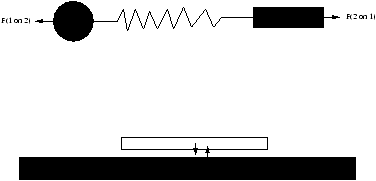
- When two bodies interact they exert on each other equal but opposite forces
F1 on 2 = -F2 on 1
From the third law
m1v1+m2v2=constant
therefore conservation of momentum
-
Statement of Definition
- define P=mv
- Statement of Physics
- momentum is conserved
Part II
One Dimensional Motion
Mathementical formulation of Newton II
F=ma
This is a vector equation however F is a vector sum of all the forces acting on a body.
Fx(x,y,z,x,y,z,t)=mx
Fy(x,y,z,x,y,z,t)=my
Fz(x,y,z,x,y,z,t)=mz
F may depend on:
-
the position vector r
- the velocity of the body
- the time depending forces
7 variables have to be considered. Taking this into account the original equation is actually more complex.
Part III
Vibrational Motion
Part IV
Two Body Dynamics
Part V
Relativity
Part VI
Motion in 3-Dimensions
Part VII
Rigid Body Dynamics
Part VIII
Motion in Rotating Frames
This document was translated from LATEX by
HEVEA and HACHA.