Chapter 1 The Meaning of Newton's Laws
If the laws of nature are to be tested by experiment all quantities are to be measurable.
1.1 Newton I
Isolated bodies maintain constant velocity, therefore velocity is relative to some reference frame and a time scale, a frame in which Newton's I holds (inertial frame).
Assumptions:
-
space is homogeneous
- space is isotropic (laws of mechanics are unchanged by rotation)
- space is Euclidean (this means things like Pythagoras are true)
- time is universal (all observers agree when events occur)
However if Newton's Laws are valid in a given frame, they will be valid in any frame moving with constant relative velocity.
v' = v - u
where:
-
v'
- velocity seen from frame moving with velocity u with respect to first frame
- v
- velocity of particle in one inertia frame
Principle of Mechanics states that mechanical experiments cannot determine who is 'at rest', accelerations however can be detected.

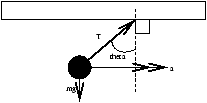
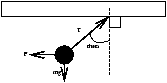
For example: Rubber bob on accelerating train
Observer on Platform (inertial frame):
Observer on Train (non-inertial frame)
horizontal force=T sin q
via Newton II T sin q = ma
Requires Balancing Force:
F+Tsin q =0
F=-ma
where 'a' is the acceleration of the frame
F is a fictious force, inertial force resulting from using Newton's Laws in a non-inertial frame. The force does not originate from any physical source.
Inertial Frame is a frame in which a body obey's Newton I when no force acts.
However how do we know there is no force? When a body moves with constant velocity. This is self referencing its-self (tautology), so how do we know what is an Inertial Frame? We resort to successive approximations to achieve an inertial frame.
-
Deep Space - coarset 'clumpiness' of universe is 150 million light years (~ 1025m)
- Frame of 'fixed stars' in our galaxy - useful for analysising planetary motion
- Earth - difficult to test Newton I as gravity is present in a standard ground based lab frame. Other complications include the centrifeugal, Cariolis force (see later section), inertia forces caused by the earths rotation
Centrifugal term: mwE2RE
acceleration (centrifugal)=wE2RE
where:
-
wE
- angular velocity of earth
- RE
- radius of earth
force ~ 0.007g
Can we do better by 'getting rid' of gravity? Consider the 'lift cabin':
-
Observer on ground see's all objects, the lift cabin and the man inside, accelerate downwards with acceleration g=-gk
- In the accelerating lift cabin frame the net force is given by mg+F where mg is the bodies weight and F is the inertial force -ma , a being the acceleration of the lift. When a=g the net force is:
mg+(-ma)=0
So the net force on any object observed in this frame is zero. It is in this artificially created frame we can test Newton's I Law.
According to Einstein the free-fall situation is in fact identical to the 'free-float' space ship.
1.2 Newton II
Newton II in an inertial frame
F=ma
Measurable mass? ie compare one mass with a standard mass.
In order to do this subject test mas and standard mass to the same force and observe the acceleration.
Using the idea's of Newton III through a medium such as a spring. The subject mass and test mass to equal and opposite forces.
compare accelerations:
since F2 on 1=F1 on 2 (and we only care about magnitude)
1.2.1 Inertial vs Gravitational Mass
Newton's law of gravity, force F on one body (eg test object of mass mg due to a second body (eg earth, MG is
where 'r' is the distance connecting the centres of the two masses.
By Newton II: F=mIa
we make the distinction between two sorts of mass
-
gravitational mG the 'charge' appearing in Newton's law of gravitation
- inertial mass mI is the ratio of force to accelerate in Newton II

Tower of Pisa Experiment - Galileo:
Applying Newton's laws to the two bodies:
this if the ratio mG/mI is the same for all bodies, then all bodies will fall with the same acceleration. ie near the earth's surface a1=a2=g
If not then the bodies will seperate as they fall. Modern experiments have tested the equality between gravitational and inertial mass to better than one part in 1012
experimentally mI/mG=constant however by a choice of units mI=mG
This experiment suggests that gravity is an inertial force - this is the basis of Einstein's gereral relativity.