Previous Contents Next

Chapter 2   Particle Motion

Particles have no size, dimension structure or orientation, eg an electron is a particle. However a cosmologist may consider a whole galaxy as a particle.

2.1   Motion with a Constant Force

The constant implies the force doesn't change with respect to position or time.
F=m
d2x
dt2
as 'm' and 'F' are constants
d2x
dt2
=x=constant=a

æ
è
ó
õ
a dt =
ö
ø
 
dx
dt
=v=x=v0+at
æ
è
ó
õ
v dt =
ö
ø
 x=x0+v0t+
1
2
at2
by substituting t: v2=v02+2a(x-x0)

where:
x0
is the initial position
v0
is the initial velocity
F=m
dv
dt
ó
õ
x


x0
F dx=m ó
õ
x


x0
dv
dt
dx
however dx=dx/dtdt and dv=dv/dtdt
ó
õ
x


x0
F dx=m ó
õ
v


v0
v dv
F ó
õ
x


x0
dx=m ó
õ
v


v0
v dv
F(x-x0)=
1
2
mv2-
1
2
mv02

2.1.1   Work Done

Define the left hand side òx0xF dx to be the work done by the force on the particle in moving it from x0 to x.

2.1.2   Kinetic Energy

Define kinetic energy (energy of a particle due to its motion):
K=
1
2
mv2
or in terms of its momentum:
p=mv K=
p2
2m

Work done(net) = Increase in Kinetic Energy (K) [The Work-Energy Theorem]:
W=K-K0=D K
Units of Energy: The Joule is the energy used by a force of one newton acting through one metre.

2.1.3   Impulse and Power

ó
õ
F dt= ó
õ
m
dv
dt
dt
F ó
õ
t


0
 dt=m ó
õ
v


v0
 dv
Ft=mv-mv0
Impulse = D p

2.1.4   Power

P=
dW
dt
=F
dx
dt
Therefore Power=Force x Velocity, units are the Watt (Joules per second)

2.1.5   The Free Fall Particle Example

Gravity provides the constant force (in the 'z' direction, up is the positive direction of 'z'), when close to the earth's surface.
Fz=-mg
Work done by gravity from z0 to z:
W= ó
õ
z


z0
Fz dz= ó
õ
z


z0
-mg dz=-mg(z-z0)=-mgh
the minus sign is do to the direction of travel.

2.2   Motion with a Force Depending On Position

mx=F(x)
Cannot integrate with respect to 't' directly, note dx=dx/dtdt=v dt
ó
õ
x


x0
m
dv
dt
dx= ó
õ
x


x0
F(xdx
1
2
mv2-
1
2
mv02= ó
õ
x


x0
F(xdx=D K (work done by F)

2.2.1   Generalised Work-Energy Theorem

Define ò F(xdx º -U(x)
F(x) º
-dU
dx
where: U(x) is the potential function of the particle substitute this with the Work-Energy Theorm:
1
2
mv2-
1
2
mv02=-U(x)+U(x0)
1
2
mv2+U(x)=
1
2
mv02+U(x0)=E

Constant in Time?

dE
dt
=
d
dt
(
1
2
mv2)+
d
dt
U(x)=mv
dv
dt
+
dU
dt
dx
dt
=Fv+(-F)v=0

2.2.2   The Free Fall Particle Example

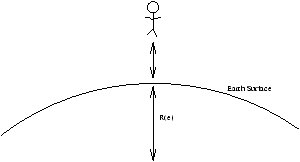
A particle is released from rest a long way from the earth's surface, with what speed will it hit the earth?
1
2
mv2-
1
2
mv02= ó
õ
x


x0
F(zdz
F(z) is the gravitational force between the body (of mass m) and the earth (of mass M).
F(z)=
-GMm
z2
1
2
mv2= ó
õ
z


z0
-GMm
z2
dz=
GMm
z
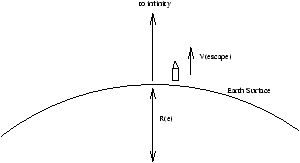
as z0 ¥; z=RE
1
2
mv2=
GMm
RE
v=
2GM
RE
where:
G
is 6.672× 10⁻¹¹ Nm2kg-2
M
is 5.98× 1024 kg
RE
is about 6.4× 10⁷ m
v=1.12x10⁴ ms-1~ 11 kms-1
This also works the other way around, ie v~ 11 kms-1 is the minimum speed which must be given to a body at the earth's surface to escape earth's gravity - this is known as the escape velocity.

Comments:
  1. F=F(x) allows a definition of a form of energy, potential energy function U(x) . If it is possible to write F(x)=-dU/dx then F(x) is a conservative force; eg friction is not a conservative force as it depends on v=x
  2. energy conservation can be extended to include non-conservative forces if we include other forms of energy (such as heat)
  3. can add any constant to U(x) and still E is conserved
    K-K0=U(x0)-U(x)
    only the difference is significant. compare to K=1/2mv2 not arbitrary because K=0 when v=0
  4. K and U are scalers and so are simpler to use than vectors in 3D
  5. energy and momentum conservation are derived forms of Newton's laws - but have been experimentally verified for all phenomena even when Newton's Laws don't apply.

2.3   Potential Functions

eg U(x)=k/x
Force=
-dU
dx
=-(
-k
x2
=
k
x2
for K>0 , force is in the positive x direction for K<0 , force is in the negative x direction

eg Gravity: K=-GMm
Electromagnetic : K=Q1Q2/4p e 0
for the general potential function the total energy E=K+U is conserved
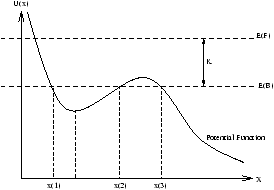
If E=EF
then K=EG-U>0 and the particle is free and escapes to x=+¥
If E=EB
and x>x3 , particle is free
and x1<x<x2 , particle is bound
and x<x1 or x2<x<x3 , impossible because kinetic energy would be negative
Equilibrium points are all at turning points
  1. v=0
  2. F=-dU/dx=0

2.3.1   Equilibrium Types

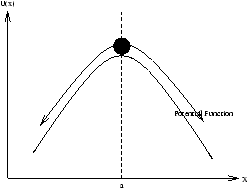
  1. stable: U''(a)>0
  2. unstable: U''(a)<0
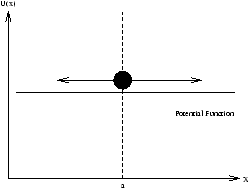
  3. neutral: U''(a)=0

    will have to determine system stability through higher derivitives


2.4   Motion Near A Stable Equilibrium Point

Let x=a be a stable equilibrium point. Near to equilibrium expand U(x) as a Taylor Series:
U(x)=U(a)+U'(a)(x-a)+
1
2!
U''(a)(x-a)2+...
The second term equals zero as we are analysing an equilibrium point, hence
U(x)~ U(a)+
1
2
U''(a)(x-a)2
let X=x-a
U(X)=U(0)+
1
2
U''(0)X2
now
F=
-dU
dX
=-U''(0)X=-kX
By Newton II Þ mx=-kx
Hooke's Law Þ k=U''(X=0)=U''(x=a)
U(x)=U(a)+U'(a)(x-a)+
1
2
U''(a)(x-a)2+...
Let X=x-a
U(X)=U(0)+
1
2
U''(0)X2
now
F=
-dU
dx
=-U''(0)X
F=-U''(0)X=mx
where:
F
is the restoring force of Hooke's Law
U''(0)
is the spring constant
A solution to the above force
X=Asin(w t)
X=-w 2X=U''(0)X
F=-mw 2X
w=
U''(0)
m
=
k
m
T=
2p
w
=2p
m
U''(0)
Hooke's Law is not a fundemental law of physics, it is simply a consequence of studying any (conservative) system close to a stable equilibrium point.

2.5   Motion with a Velocity-Dependent Force - Resistive Motion

Now F=F(v) is non-conservative force. U(x) is not defined; eg fluid friction where Fµ v , this generally works only for low speeds, high speeds are Fµ v2 .


For a parachutist take the positive as down
Fresistive=-bv
'b' characterizes the fluid resistance, units are kgms-2º b× ms-1 Þ b=kgs-1
By Newton's II
mg-bv=m
dv
dt
ó
õ
v


0
m
mg-bv
= ó
õ
t


0
dt
-
m
b
ln [mg-bv]0v=t
v=
mg
b
[1-e
-
bt
m
 
]
as t ¥
v
mg
b
=v
 
¥
=terminal velocity
mg=bv
v=v
 
¥
[1-e
-
gt
v
 
¥
 
]
æ
è
ó
õ
v dt=x(t)
ö
ø

2.5.1   Challenge

What if Fµ v2 instead?
Previous Contents Next