Previous Contents Next

Chapter 23   Lecture 22 - Temporal Evolution of Quantum Systems

t
Y (r,t)=HY (r,t)     (23.1)
State evolution is determined by the Hamiltonian H

23.1   Evolution of Energy Eigenstates

Yn(r,t) is the energy eigenstate
HYn(r,t)=EnYn(r,t)
so thetemportal dependence will be of the form
Yn(r,t)=un(r )e
En
 
t
 
    (23.2)
where eEn/t is the time dependent phase factor

23.2   Evolution of an Expectation Value

Often it is important to know how expectation values of an observable evolve
<A >= ó
õ


all space
Y*(r,t)AY (r,t)dV
d
dt
<A >= ó
õ


all space
é
ê
ê
ë
Y*(r,t)
d
dt
AY (r,t)+
Y*(r,t)
t
AY (r,t)+Y*(r,t)A
Y (r,t)
t
ù
ú
ú
û
dV     (23.3)
and from equation V.1 we can obtain
Y (r,t)
t
=-
 
HY (r,t)
Y*(r,t)
t
=
 
( HY (r,t) )
*
 
 
    (23.4)
By putting these into equation V.3 and using the definition of a Hermitian operator
ó
õ


all space
 
( HY (r,t) )
*
 
 
AY (r ,t)dV= ó
õ


all space
 
Y*(r,t)HAY (r,t)
d<A>
dt
= ó
õ


all space
Y*(r,t)
dA
dt
Y (r,t)dV+
 
ó
õ


all space
Y*(r,t)[HA-AH]Y (r,t)dVº [H,A]
d<A>
dt
=
dA
dt
+
 
<[H,A]>     (23.5)
The outcomes of this equation are that If A commutes with hatH it must be a conserved quantity since
d<A>
dt
=
 
<[H,A]>=0     (23.9)
So for instance in a central potential L2 and Lz are conserved -conservation of angular momentum.

23.3   Evolution in a Time Varying Potential

Ignoring spatial dependence we can often cast the time dependent Hamiltonian in the form
H=H0+V(t)
where H0 is a time independent Hamiltonian whilst V(t) is time dependent. eg. a system interacting with electromagnetic radiation, molecules colliding, etc.
Y (r,t)
t
=[H0+V(t)]Y (r,t)     (23.10)
we now have two cases to deal with
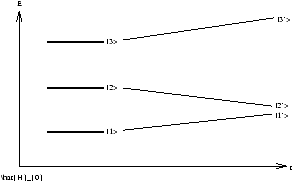
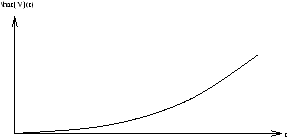
  1. if V(t) changes slowly in comparison to the phase factors ( e-En/t ) of the eigenstates of H0 , then the system has time to slowly evolve into new eigenstates, this process is known as Adiabatic Limit.
    t >>
    En
    where t is the time scale of change in V(t) .

    Figure 22.1 - Eigenstates and Energies Evolving Smoothly

    Figure 22.2 - V(t) Evolving Smoothly
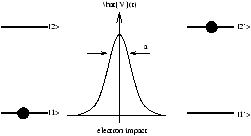
  2. if V(t) changes rapidly, eg. on a timescale comparable to the phase factors ( e-En/t ) of the eigenstates of H0 , then there is no time to evolve into a new eigenstates The outcome of thisi n this case is that the transitions are made between the eigenstates of H0

    Figure 22.3 - A Fast Collison
    Y (0)+U1(r )e
    -
    En
     
    t
     
    ® Y (t)=aU1(r,t)+bU2(r,t)

Previous Contents Next