Previous Contents Next

Chapter 22   Lecture 21 - Spin

22.1   The Nature and Discovery of Spin

Spin is an intrinsic property of a particle, it interacts with a magnetic field as if it were an angular momentum with l=1/2 .

It was discovered by observations of electrons in magnetic fields It is found to be a natural consequence of Dirac's Relativistic Quantum Theory (1925).

22.2   The Interaction of Angular Momentum With a Magnetic Field

A particle with a magnetic moment µ has rhe interacting energy
Eint=-µ.B     (22.1)
fir an electron circulating about a point
µ=
r
2me
.l     (22.2)
so if we consider a magnetic field aligned with the z-axis we can deduce the interactions Hamitonian.
Hint=-
r
2me
.BzLz     (22.3)
since the eigenstates of Lz have eigenvalues m
Eint=-µBmBz     (22.4)
where
µB=
e
2me
    (22.5)

22.3   Stern-Gerlach Experiment (1925)

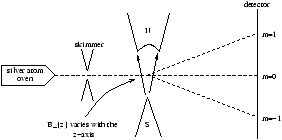
Classically the force in the z-direction acting on a particle is
F=-
d
dz
V(z)
Thus if we have a varying magnetic field Bz(z)
FatomBm
z
Bz(z)     (22.6)
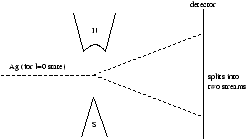
therefore we expect the deflection to be proportional to m . If l=0 and so m=0 we have no deflection however if l=1 we get -1 , 0 or 1 for the deflection direction.

Figure 21.1 - Stern-Gerlach Experiment (1925)

Figure 21.2 - The Results of the Stern-Gerlach Experiment (1925)
Uhlenbech and Goudsmit (1925) pointed out that this is consistent with
l=
1
2
,  m
1
2
thus this was evidence for 1/2 unit intrinsic angular momentum.

22.4   Spin States and Operators

Formal theory gives spin operators S2 and Sz
S2c =s(s+1)2c     (22.7)
Szc =msc     (22.8)
where c is the spin states for an electron when s=1/2 ad m=±1/2 .

Thus we define that when ms=+1/2 then the spin is in the up state, however if ms=-1/2 then the spin is in the down state. This leads to a two state system. Also
S 2c
 
1
2
=
3
4
2c
 
1
2
    (22.9)
s=1/2 for a whole host of fermions such as protons, muons, neutrons, and electrons. However for a p -muon, s=0 and for a photon s=1 .

The interaction with a magnetic field
Eint=-g
e
2me
msBz
where g~ 2 for the electron ( m0=me ) and is due to fluctuations in the electromagnetic spectrum. g is known as the gyromagnetic ratio.
protons:
g=56 ( m0=mp )
neutrons:
g=-36 ( m0=mn )
since c is a two state system so it is convienent to represent it as a two component vector
c
 
+
1
2
= æ
ç
ç
è
1
0
ö
÷
÷
ø
,  c
 
-
1
2
= æ
ç
ç
è
0
1
ö
÷
÷
ø
    (22.10)
this is called the Dirac Spinners therefore the operators Sz and S2 are 2× 2 matrices
Sz=
2
æ
ç
ç
è
1 0
0 -1
ö
÷
÷
ø
=
2
sz,  Sy=
2
æ
ç
ç
è
0 -1
1 0
ö
÷
÷
ø
=
2
sy,  Sz=
2
æ
ç
ç
è
0 1
1 0
ö
÷
÷
ø
=
2
sx     (22.11)
so sz , sy and sx are known as the Pauli Matrices.
S2=Sx2+Sy2+Sz2=
3
4
2 æ
è
1 0
0 1
ö
ø
    (22.12)
for example
S zc
 
+
1
2
=
2
æ
è
1 0
0 1
ö
ø
æ
ç
ç
è
1
0
ö
÷
÷
ø
=
2
æ
è
1
0
ö
ø
    (22.13)
S zc
 
+
1
2
=
3
4
2 æ
ç
ç
è
1 0
0 1
ö
÷
÷
ø
æ
ç
ç
è
1
0
ö
÷
÷
ø
=
3
4
2 æ
ç
ç
è
1
0
ö
÷
÷
ø

Previous Contents Next