


Chapter 19 Lecture 18 - Operators for Angular Momentum and Their Commutation Relations
19.1 Angular Momentum Operator
In one dimension linear momentum is
therefore in three dimensions linear momentum now becomes
p=-Ñ (19.1)
L=r×p=-(r×Ñ) (angular momentum) (19.3)
|
Lx=- |
æ
ç
ç
è |
y |
|
-z |
|
ö
÷
÷
ø |
Ly=- |
æ
ç
ç
è |
z |
|
-x |
|
ö
÷
÷
ø |
Lz=- |
æ
ç
ç
è |
x |
|
-y |
|
ö
÷
÷
ø |
(19.4) |
If they had terms such as y and py we would be in big trouble due to simultaneous measurement of incompatible quantities.
Equation IV.18 expressions can be generated from each other by applying a rule of cyclic permutation
x® y, y® z, z® x
L2=Lx2+Ly2+Lz2 (19.5)
this is the total angular momentum squared. Often it will be most convenient to use spherical polars in this coordinate frame. We have the important ones
|
L2=-2 |
é
ê
ê
ë |
|
+cotq |
|
+ |
|
|
ù
ú
ú
û |
(19.7) |
19.2 Compatibility of Angular Momentum Operators
The physical considerations in polars are
this has a close analogy to pz=¶/¶ z we recall that there is an uncertainity relation
so z and pz are not compatible and so therefore we anticipate a similar uncertainity relation between f and -¶/¶f
If Lz is perfectly defined ( D LZ=0 ) this implies f must be completely uncertain (ie. has any value between 0 and 2p with equal probability).
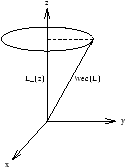
Figure 18.1 - Complete Uncertainity in
f
f is undefined therefore the x and y components of L must also be undefined if Lz is defined. Therefore we say that Lz is incompatible with Lx and Ly .
19.3 Communtation Relations Between Angular Momentum Operators
| [Lx,Ly]=2 |
é
ê
ê
ë |
æ
ç
ç
è |
y |
|
-z |
|
ö
÷
÷
ø |
, |
æ
ç
ç
è |
z |
|
-x |
|
ö
÷
÷
ø |
ù
ú
ú
û |
| [Lx,Ly]=-2 |
æ
ç
ç
è |
y |
|
-z |
|
ö
÷
÷
ø |
=2 |
æ
ç
ç
è |
x |
|
-y |
|
ö
÷
÷
ø |
[Lx,Ly]=Lz
[Ly,Lz]=Lx
[Lz,Lx]=Ly (19.9)
so we find that Lx , Ly and Lz are incompatible obserables. So what about [L2,Lz] ?
[L2,Lz]=[(Lx2+Ly2+Lz2),Lz]
[L2,Lz]=0
it can also be shown that
[L2,Lx]=0
[L2,Ly]=0
[L2,Lx]=[L2,Ly]=0 (19.10)
The total angular momentum is compatible with each individual component (provided that we only look at one component).
We have the simultaneous eignestates of L2 and Lz , but if we try to measure (say Lx ) we destroy our information about Lz .