


Chapter 18 Lecture 17 - Three Dimensional Systems
18.1 Introduction
If we go beyond one dimension the basic rules of Quantum Mechanics are unchanged. The only implications are that
-
we have to be aware of the geometry and symmetry of our system and choose an appropriate coordinate system to work in
- in three dimensions we have also to consider angular momentum
18.2 Three Dimensional Hamiltonian
Schrödinger's Equation in one dimension is
| |
é
ê
ê
ë |
- |
|
|
+V(x) |
ù
ú
ú
û |
Y (x)=EY (x) |
|
|
é
ê
ê
ë |
- |
|
Ñ2+V(r) |
ù
ú
ú
û |
Y (r)=EY (r) (18.1) |
V(r)=V(x,y,z)
Y (r)=Y (x,y,z)
This is convienent if the basic geometry is compatible (eg. a crystal lattice). Often it is more appropiate to work with spherical coordinates. For example in atoms and nuclei as there is a central symmetry.
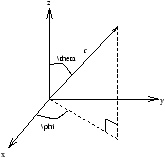
Figure 17.1 - The Spherical Coordinate System
In spherical polars we have
|
Ñ2= |
|
+ |
|
|
+ |
|
æ
ç
ç
è |
|
+cotq |
|
+ |
|
|
ö
÷
÷
ø |
(18.3) |
V(r)=V(r,q ,f )
Y (r)=Y (r,q ,f )
So to integrate (in the form òall space[<integrand>]dV ) over the volume:
-
cartesian:
-
|
|
ó
õ |
|
ó
õ |
|
ó
õ |
|
[ ]dxdydz (18.4) |
- spherical polar:
-
|
|
ó
õ |
|
ó
õ |
|
ó
õ |
|
[ ]r2sinqdq df dr (18.5) |
18.2.1 Example - Normalisation of a Three Dimensional Wavefunction
The S-State of Hydrogen is
| |c|2= |
ó
õ |
|
ó
õ |
|
ó
õ |
|
e |
|
r2sinqdq df dr=1 |
18.3 Parity
Symmetry considerations give an important insight, this helps us with
-
boundary conditions
- compatibility of measurements
We define a parity transformation associated with the parity operator ( P )
PY (x,y,z)=Y (-x,-y,-z) (18.6)
If the system has a well defined parity (definate parity) then
PY (x,y,z)=±Y (x,y,z) (18.7)
however the parity transformation in spherical coordinates is
PY (r,q ,f )=Y (r,p -q ,f +p ) (18.8)
On the compatibility of these operators
[P,p2]=0 compatible (18.9)
in a central potential
[P,H]=0 (18.10)
ie. in a symmetric potential, eigenstates of energy are also eigenstates of parity
18.4 Angular Momentum
In addition to linear momentum there is now a (rotational) angular momentum
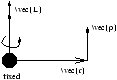
Figure 17.2 - Angular Momentum
In a central potential angular momentum is conserved (both classically and quantum mechanically)
L=r×p (18.11)
In cartesian coordinates
|
L= |
½
½
½
½
½ |
|
|
|
½
½
½
½
½ |
=ilx+jly+klz (18.12) |
lx=ypz-zpy ly=xpz-zpx lz=xpy-ypx (18.13)
so we can define a quantity that is the total angular momentum
|L|2=lx2+ly2+lz2 (18.14)