Previous Contents Next

Chapter 16   Lecture 15 - Eigenstates of the Quantum Harmonic Oscillator - Continued

16.1   Hermite Polynominals

Yn(b ) is generated by applying A n times to Y0(b ) .
Yn(b )µ (A
 
 
)nY0(b )     (16.1)
The normalisation of (A)nY0(b ) results in the normalisation eigenfunctions.
Yn(b )= æ
ç
ç
è
1
2nn!
ö
÷
÷
ø
1
2


C0Hn(b )e
-
b2
2
 
We say that the Hn(b ) 's are the polynominals in b (or x ) of order n and are called Hermite Polynominals.

Some important features of the wave functions

16.2   Comparision To The Classical Harmonic Oscillator System

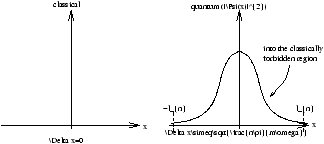
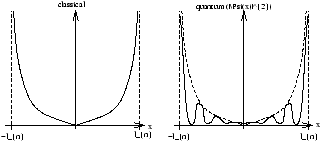
We can consider the probability distribution for position in quantum and classical oscillators

Figure 15.1 - For a Low n State

Figure 15.2 - For a High n State
The classical turning points by definition are
En=V(x)
æ
ç
ç
è
n+
1
2
ö
÷
÷
ø
w =
1
2
mw2ln2
this is where ln is x and so the outcomes of this are so for a high n classical and quantum probability distributions do become broadly similar.

16.3   Vibrational States of Diatomic Molecules

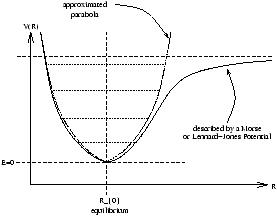
The interatomic potential in a diatomic molecule is approximately parabolic

Figure 15.3 - Parabolic Approximation of Diatomic Molecules
so the potential is
V(R)=
1
2
mw2(R-R0)     (16.2)
strictly speaking m is replaced by the reduced mass µ . So
V(x)=
1
2
mw2x2
we find a zero point vibrational energy state at
E0=
1
2
w
and so the energies of the excited states are
En= æ
ç
ç
è
n+
1
2
ö
÷
÷
ø
w
The study of spectra comfirms this and gives values for w . eg.
HCl®w =0.36eV
CO®w =0.27eV
if n is high the atoms are likely to be formed near the turning point (this is simple harmonic motion)

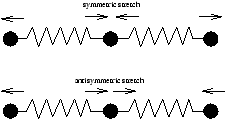
16.4   The Vibrational Modes of a Crystal Lattice

We are interested in The mean energy per mode is determined by the Boltzmann distribution
<E>q=
 
å
m
æ
ç
ç
è
m+
1
2
ö
÷
÷
ø
wqe
-
æ
ç
ç
è
m+
1
2
ö
÷
÷
ø
wq
kT
 
 
å
m
e
-
æ
ç
ç
è
m+
1
2
ö
÷
÷
ø
wq
kT
 
    (16.4)
Þ <E>q=
wq
e
wq
kT
 
-1
+
1
2
wq     (16.5)
A similar proceedure for the quantisation of energy for the electromagnetic modes of a cavity leads to photons
En= æ
ç
ç
è
n+
1
2
ö
÷
÷
ø
w
where this is the energy of the nth excited state of mode and the w is the photon energy.
Previous Contents Next