Previous Contents Next

Chapter 15   Lecture 14 - Ladder Operators and Solution of the Quantum Harmonic Oscillator

15.1   Action of (matrix)A and (matrix)A(dagger)

we recalls that
æ
ç
ç
è
A
 
 
A+
1
2
ö
÷
÷
ø
Yn(b )=enYn(b )
é
ê
ê
ë
(also æ
ç
ç
è
AA
 
 
-
1
2
ö
÷
÷
ø
Yn(b )=enYn(b ) ù
ú
ú
û
consider the result of operating on both sides of these reduced simulatenous equation with A .
A æ
ç
ç
è
A
 
 
A+
1
2
ö
÷
÷
ø
Yn(b )=AenYn(b )
AA
 
 
(AYn(b ))+
1
2
(AYn(b ))=eN(AYn(b ))
we can treat AYn(b ) as some new functino of b
æ
ç
ç
è
AA
 
 
+
1
2
ö
÷
÷
ø
(AYn(b ))=en(AYn(b ))     (15.1)
this is trivially equivalent to
æ
ç
ç
è
AA
 
 
-
1
2
+1 ö
÷
÷
ø
(AYn(b ))=en(AYn(b ))
so
æ
ç
ç
è
AA
 
 
-
1
2
ö
÷
÷
ø
(AYn(b ))=(en-1)(AYn(b ))     (15.2)
we saw that equation III.49(b)
H=AA
 
 
-
1
2
so equation III.51 is an energy eigenvalue equation for the state ( AYn(b ) ) with an energy en-1 . So state Yn(b ) had energy en .

The operator A has the effect of lowering the energy of the state Yn by one unit. ie. by w
AYn(b )µ Yn-1(b )     (15.3)
A is a lowering operator. It can be shown by an equivalent analysis that
A
 
 
Yn(b )µYn+1(b )     (15.4)
so A is a raising operator.

Hence why A and A are called Ladder Operators.

15.2   Energy Eigenvalues of the Quantum Oscillator

Since A and A are lowering and raising operators for the state of the harmonic oscillator where
A :
en®en-1 [ -w ]
A :
en®en+1 [ +w ]
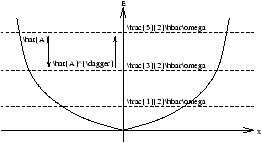
we can conclude that these states form an evenly spaced sequence, seperated by w .
En+1-En=w
The question is where does this sequence start? The lowest state Y0(b ) by definition has no state below it, so
AY0(b )º 0     (15.5)
we can now use equation III.54 to calculate Y0(b )
HY0(b )= æ
ç
ç
è
A
 
 
A+
1
2
ö
÷
÷
ø
Y0(b )=
1
2
Y0(b )     (15.6)
e0=
1
2
® E0=
1
2
w     (15.7)
This is the so called zero point energy of the harmonic oscillator.
En= æ
ç
ç
è
n+
1
2
ö
÷
÷
ø
w     (15.8)

Figure 14.1 - Plot of En for Harmonic Oscillator

15.3   Eigenstates of the Harmonic Oscillator

we saw that Y0(b )=0
1
2
æ
ç
ç
è
b +
d
db
ö
÷
÷
ø
Y0(b )=0
so with some rearrangement
Þ
d
db
Yn(b )=-bY0(b )     (15.9)
the solutions of this differential equation are
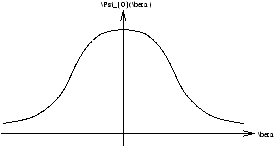
Y0(b )=C0e
-
b2
2
 
    (15.10)

Figure 14.2 - Y0(b ) is a Reduced Gaussian Function
so the normalisation constant C0 is
C0=
1
ó
õ
¥


-¥
e
-b2
 
db
= æ
ç
ç
è
1
p
ö
÷
÷
ø
1
4


    (15.11)
In terms of x the wavefunction becomes
Y0(x)= æ
ç
ç
è
mw
p
ö
÷
÷
ø
1
4


e
æ
ç
ç
è
-
mw
2
x2 ö
÷
÷
ø
 
    (15.12)
where (mw/p)1/4 is the new normalisation constant.

From here we can obtain all the eigenstates by using the ladder operators. However the eigenstate will not be normalised (which can be solved by normalising the function by hand with the normalisation constant C0 ). However this will allow us to obtain the eigenfunction.
A
 
 
Y0(b )µY1(b )
Y1(b )µ
1
2
æ
ç
ç
è
b -
d
db
ö
÷
÷
ø
C0e
-
b2
2
 
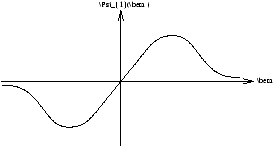
Þ Y1(b )µ
C0
2
(2b )e
-
b2
2
 
    (15.13)

Figure 14.3 - Eigenstate Y1(b )
Y2(b )µ (A
 
 
)2Y0(b )  [A
 
 
  applied twice]
Þ Y2(b )µ C0 æ
ç
ç
è
1
2
ö
÷
÷
ø
2


(4b2-2)e
-
b2
2
 
    (15.14)

Previous Contents Next