


Chapter 13 Lecture 12 - Potential Steps, Barriers and Tunneling
13.1 Potential Step
a free particle wave is incident onto a step potential, so we get a possible reflection and tranmission quantity.
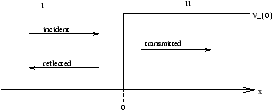
Figure 12.1 - Particle Wave Incident onto a Step Potential
-
In Region I:
-
where A is involved in the incident part of the wave equation whilst the B quantity is involved in the reflected part. Also
- In Region II:
-
where C is involved in the transmitted part of the wave equation whilst
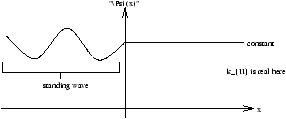
Figure 12.2 - The Wave Equation for a Step Potential when
E<
V0
The standing wave is due to the interference between the incident and reflected parts of the particle wave.
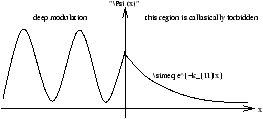
Figure 12.3 - The Wave Equation for a Step Potential when
E>
V0
But for E>V0 what are the reflection and transmission probabilities? Since Y (x) is continuous at x=0
A+B=C (13.5)
since dY (x)/dx is also continuous at x=0
kIA- kIB= kIIC (13.6)
a rearrangement of the above
|
A= |
æ
ç
ç
è |
1+ |
|
ö
÷
÷
ø |
|
B= |
æ
ç
ç
è |
1- |
|
ö
÷
÷
ø |
|
(13.7) |
|
reflection coefficient (R)= |
| reflected flux |
|
| incident flux |
|
(13.8) |
flux=(particle density)× (velocity)
for example
|
reflected flux=|Be |
|
|2× |
|
(13.9) |
R+T=1 (13.12)
13.2 Barriers and Tunneling
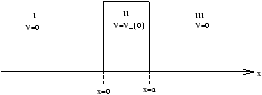
Figure 12.4 - A Particle Wave Incident on a Potential Barrier
now for E<V0 we get kII to be imaginary
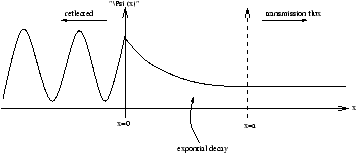
Figure 12.5 - Potential Barrier When
E<
V0
This process is called Quantum Mechanical Tunneling and is important in many applications such as:
-
scanning tunneling microscopes
- quantum well structure
- nuclei
By applying the usual boundary conditions at regions I/II and regions II/III boundaries it can be shown
where
|
g2=- |
|
(E-V0)=-kII2 (13.14) |
for when:
-
g a<<1 (thin/low barrier):
-
sinh2(g a)® 0
T=1 (13.15)
- g a>>1 (high/wide barrier):
- this means there is a low barrier penetration probability
13.2.1 The Process Of Alpha-Decay
where VN is the nuclear term and VC is the Coulomb replusion term which is proportional to (Z-2)e2/r
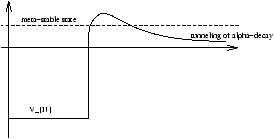
Figure 12.6 -
a -Decay Process
so
remember that the half life is proportional to 1/T so for some isotope A
g a~ 2.5® Thalf~ 1 second
and for some isotope B say where g a is double this
Thalf=1× e25 seconds~ 2283 years