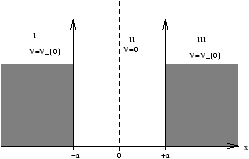
This is an important problem for realistic treatments of
certain nuclear potentials
quantum well structures
In a classical sense
E>V0 :
then the particle is free (has continous energy)
E<V0 :
then the particle is bound (has quantised energy)
In region II where V(x)=0 we can say
YII(x)=Acos(ka)+Bsin(kx) (12.1)
where k=(2mE/2)1/2 , this comes from equations III.3 and III.4.
In regions I and III where V(x)=V0 we get
2
2m
d
dx2
Y (x)=(V0-E)Y (x) (12.2)
the general solutions of this are
YI,III=CeKx+De-Kx (12.3)
K=
æ ç ç è
2m(V0-E)
2
ö ÷ ÷ ø
1
2
(12.4)
If K is an imaginary quantity then E>V0 and so free, however if K is a real quantity then E<V0 .
12.2 Form of Energy Eigenfunctions
For E<V0 :
YI,III(x)~e-K|x| , this provides the expontial decay
YII(x)~[sin(kx)cos(kx)]
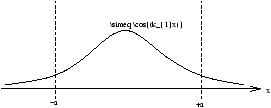
Figure 11.2 - n=1 (Lowest Energy Solution) For the Finite Well. This is Said To Have Even Parity as it is Symmetric.
Note that in a classical model the regions beyond -a and +a would be void of the particle, however Schrödinger's Equation says otherwise.
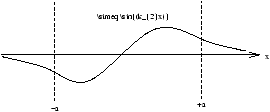
Figure 11.3 - n=2 For the Finite Well. This is Said To Have Odd Parity as it is Anti-Symmetric.
12.3 Determination of Energy Eigenvalues
For E<V0 :
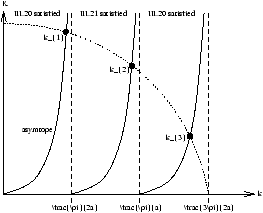
no general analytically solutions to this problem exist however it can be solved numerically or graphically. We will be looking at the graphical solution later
boundary conditions (from lecture 10)
condition i:
lim
x®¥
Y (x)® 0 (12.5)
this restricts YI and YIII to
YI(x)=CeKx YIII(x)=De-Kx (12.6)
condition i and iii
states we need Y (x) and d/dxY (x) to be continous