Previous Contents Next

Chapter 6   Electromagnetic Waves in Plasmas

Feyman 32-7
Dobbs 12-4

6.1   Introduction

Some examples of plasmas are: The definition of a plasma is "any state of matter that has enough free, charged particles for its dynamical properties to be dominated by the Electromagic forces".

There are several materials that behave like plasmas:
Solids:
metals
Liquids:
conducting fluids (such as Mercury (Hg))
Gases:
this is the most common form of a plasma
To produce a plasma you can use: The main difference in this section when compared to Section 5 is that there are no collisions so that the conduction can be described as
jf=sE
however what is s ?

6.2   Conduction in Plasmas

The equation of a condcution electron is
me
dve
dt
=-eE-
meve
tcollision
    (6.1)
a couple of points on equation 6.1 are however we have neglected that: Consider an electron responding to a wave
E µ e
-w t
 
v Eµ e
-w t
 
and so equation 6.1 gives
-w meve=-eE-
meve
tcollision
or
ve=
-eE
me æ
ç
ç
è
1
tcollision
-w ö
÷
÷
ø
we define the current density as
jf=-Neve
where N is the number of particles present per unit volume ( m-3 ) (the electron number density). So we get
jf=
Ne2E
me æ
ç
ç
è
1
tcollision
-w ö
÷
÷
ø
    (6.2)
Case A:
tcollision<<1/w where the collisions dominate
jf= æ
ç
ç
è
Ne2tcollision
me
ö
÷
÷
ø
E=sE
where s is the same one used in Section 5
Case B:
tcollision>>1/w where the collisions are weak
jf=
Ne2
mew
E     (6.3)
in this case the s is represented by Ne2/mewE .

6.3   The Wave Equation in a Collisionless Plasma

We define conductivity to be
s =
Ne2
w me
    (6.4)
if we substitute this into equation 5.3
Ñ2E0s
E
t
0e0
2E
t2
where µ =µ0 and e =e0 , to obtain
Ñ2E0 æ
ç
ç
è
Ne2
mew
ö
÷
÷
ø
E
t
+e0µ0
2E
t2
E=E 0e
(k.r-w t)
 
    (6.5)
substitute to get
-k2E=
µ0Ne2
mew
(-w )E-e0µ0w2E
tidy up
-k2=
µ0Ne2
me
-
w2
c2
to get
w2=k2c2+wp2     (6.6)
where w0=Ne2/e0me which is known as the plasma frequency. Equation 6.6 can also be written as
k=
1
c
(w2-wp2)
1
2
 
    (6.7)
so k is real or imaginary, it depends on w/wp . Looking at the outcomes of these equations we find that when:
w <w0 :
the solution is a totally imaginary wave, this is known as an evanescant wave. So a wave with w <w0 incident on a plasma is reflected. The magnitude of the evanescant wave is of the order c/wp
w >>w0 :
if w~ kc we get a pure electromagnetic wave solution
wwp :
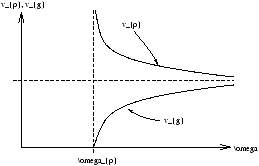
we get a dispersive wave, where the phase velocity is
vp=
w
k
=c æ
ç
ç
ç
ç
ç
è
1- æ
ç
ç
è
wp
w
ö
÷
÷
ø
2


ö
÷
÷
÷
÷
÷
ø
-
1
2


³ c     (6.8)
although the phase velocity is travelling faster than the speed of light the actual energy transmission is at the group velocity which is lower than the speed of light, so relativity is not violated
vg=
w
k
=c æ
ç
ç
ç
ç
ç
è
1- æ
ç
ç
è
wp
w
ö
÷
÷
ø
2


ö
÷
÷
÷
÷
÷
ø
1
2


£ c     (6.9)

Figure 6.1 - We Note That vpvg=c2
Typical values of wp are
wp=56.4N rads-1
np=
wp
2p
~ 9N Hz
The Ionosphere:
N~ 1012 m-3
np~Mhz
Metals:
N~ 1029 m-3
np~ 3× 10¹⁵ Hz

6.4   Examples of Plasmas

Using the equation
w2=k2c2+wp2
and we will cover Dispersion and Total Internal Relfection

6.4.1   The Earth's Ionosphere


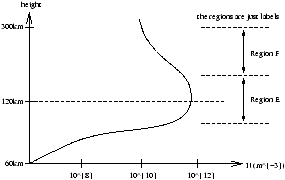
Figure 6.2 - The Profile of the Earth's Ionsphere
the maximum value of N is about 1012 m-3 so vp<10 Mhz . If n <np then the wave is reflected however is n >np it is transmitted.

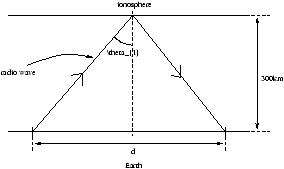
The wave can be transmitted when n >np (or w >wp ), we need to oblique incidence

Figure 6.3 - Reflection of Radio Waves Off The Ionosphere
nion=
c
vp
= æ
ç
ç
è
1-
wp2
w2
ö
÷
÷
ø
1
2


<1
however if
qI>sin-1
æ
ç
ç
è
nion
nair
ö
÷
÷
ø
=qC
we get total internal reflection. For example n =25Mhz , np=5Mhz and nion=0.98 we obtain qI~ 78° . At this angle with a height of 300km we get d=3000km .

6.4.2   Metals

For an Ohmic conductor (a conductor which obeys Ohm's Law) we get
R~ 1-
1
w
when wtcollision~ 1 we get to plasma conditions (for example copper acts like this when n³ 1013 Hz ).

The are several outcomes from this effect

X-Ray Telescope

For when
n~ 1018
we have the problem that
w >>wp
occuring at the normal incidence which results in the transmission of the radiation. However if we use metal which has the properties nmetal<1 but nmetal<1 so that the qI~p/2 we obtain a reflection. This is known as the Grazing Incidence.
Previous Contents Next