Previous Contents Next

Chapter 5   Electromagnetic Waves in Conductors


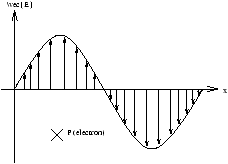
Figure 5.1 - An Electron in an Electromagnetic Wave
At point P the electric field is pointing up and so the electron is accelerated down, the outcomes of this are

5.1   Maxwell's Equations in a Conductor

The assumptions we will be making are with these assumptions we obtain the following for Maxwell's Equations in a conductor
Ñ .E=0 Ñ .B=0 Ñ×E=-µ
H
t
Ñ×H=jf+e
E
t
    (5.1)
we can relate jf to E by using Ohm's Law
jf=sE     (5.2)

If we take the curl of Faraday's Law we get
Ñ× (Ñ×E)=-µ
t
Ñ×H
Ñ (Ñ .E)-Ñ2E=-µ
t
æ
ç
ç
è
e
E
t
+sE ö
÷
÷
ø
as Ñ .E=0 we get
Ñ2Es
E
t
e
2E
t2
    (5.3)
This is known asthe Telegraph Equation. A possible solution is (assuming that it is at noramal incidence)
E (x,t)=E0e
(kx-w t)
 
y     (5.4)
by substituting the solution into equation 5.3 we get
-k2E=-wµsE-w2eµE
or
k2
w2eµ
=
s
we
+1     (5.5)
from this we find that the solution is complex so we set k to be
k=kr+ ki
by subsituting this into equation 5.4 we obtain
E (x,t)=E0e
(krx-w t)
 
e
-kix
 
y     (5.6)
where e (krx-w t) is the oscillatory part of the solution and e-kix is the damped part.

5.2   Waves in Good Conductors

By going to the Ampere-Maxwell equation
Ñ×H=sE+e
E
t
we can say that a good conductor has
|sE|>> ½
½
½
½
e
E
t
½
½
½
½
or
s >>we     (5.7)
this equation is okay for radiation incident upon a metal for visible light and also for lower frequencies (energies) than visible light. For example for copper at 1Mhz
s
we
~ 1012
for this equation 5.5 becomes
k2
w2µe
=
s
we
so
-k=w
sµ
w
by using de Moivre's theorem
=e
p
2
 
so
=e
p
4
 
=cos
p
4
+sin
p
4
therefore
=
1+
2
k=w (1+ ) æ
ç
ç
è
sµ
2w
ö
÷
÷
ø
1
2


    (5.8)
and so
k=(1+ )kc
where
kc= æ
ç
ç
è
wsµ
2
ö
÷
÷
ø
1
2


  (kc>>kvacuum)
finally
E (x,t)=E0e
-kcx
 
e
(kcx-w t)
 
y     (5.9)
this is the equation for a wave undergoing damped oscillation. The properties of this equation are
Velocity and Wavelength:
the phase speed is
vp=
w
kr
=
w
kc
=
2w
µs
    (5.10)
where
vp
c
=
2we0
s
<<1
this property implies that the wave is dispersive, this means that vp depends on w .

For example if we take radiation of frequency 1Mhz upon copper and that sCu=5.7× 10⁷ Ohm-1m-1 and so
vp=419 ms-1~ 10-6c
and
l =0.4× 10⁻³ m
(where in a vacuum l~ 300 m )
Attenuation and Skin Depth:
we define skin depth ( d ) as the distance in which the wave amplitude falls to 1/e~ 0.368 of its original amplitude. So equation 5.9 gives
d =
1
kc
=
2
wµs
    (5.11)

For copper at 1Mhz we find
d =66× 10-6 m
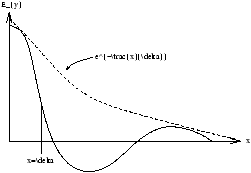
Profile of the Wave:

Figure 5.2 - The Profile of the Wave
Resistivity for High Frequency Waves:

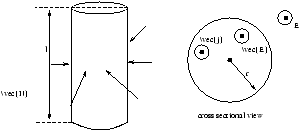
Figure 5.3 - Direct Current in a Wire
by integrating over the cross section we get
j=sE
I=s Ep r2
v=El
I=s v
p r2
l
=
v
RDC
Rdirect current=
l
p r2s
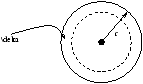
If we now consider the electric field only in the layer d

Figure 5.4 - The Electric Field in the Layer d
again we integrate by using Ohm's Law
I= ó
õ
j.dS
=s ó
õ
E.dS
I=s E2p rd
Rhigh frequency=
V
I
=
El
I
=
l
2p rds
if we now use equation 5.11
Rhigh frequency=
l
2p r
µw
2s
    (5.12)
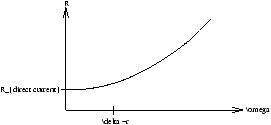
the ratio of this is
RDC
Rhigh frequency
=
2d
r
<<1

Figure 5.5 - Resistivity Due to Frequency
Magnetic Field in a Conductor:
H=
k
µw
(x×E)
where k=(1+ )kc and k=x , substituting this into equation 5.9 gives us
H=
(1+)kc
µw
E0e
-kcx
 
e
(kcx-w t)
 
z
because 1+ =2ep/4 we get
H=
s
µw
E0e
-kcx
 
e
(kcx-w t+
p
4
)
 
z     (5.13)
and kc=1/d . This gives a phase difference with respect to the electric field of p/4 .

The impedence
ZC=
Ey
Hz
=
µw
s
e
-
p
4
 
e
-
p
4
 
=
1-
2
Zc=(1- )
µw
2s
=(1- )
kc
s
    (5.14)
for example copper at 10GHz gives
|Z|c=0.036W
which is much less than the impedence in a vacuum

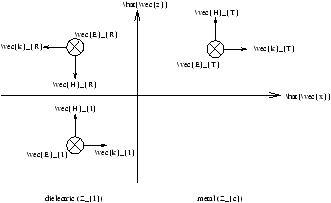
5.3   Reflection at a Dielectric to Metal Interface


Figure 5.6 - Reflection at a Dielectric to Metal Interface
We will assume a normal incidence so that k=kx . The dielectric medium will have a impedence of Z1 and the metal medium will have an impedence of Zc .

We use the Fresnel equations (equations 4.15 and 4.17) for when qI=0
ER0
EI0
=
Zc-Z1
Zc+Z1
we have
Zc
Z1
=(1- )
kc
Z1s
=(1- ) a
where a=kc/Z1s<<1 as it is a good conductor.
ER0
EI0
=
(1- )a-1
(1- )a+1
if we manipulate this we get
ER0
EI0
=
-1-2 a+2a2
(a+1)2+a2
we can neglect the a2 as a<<1 so
ER0
EI0
=-
1+2 a
1+2a
~ -1
so upon reflection we find there is a phase shift of p . The reflection co-efficient is defined as
R= ½
½
½
½
ER02
EI02
½
½
½
½
~ 1-4a
R=1-2
2we
s
    (5.15)
so R~ 1 means a complete reflection back.

For example copper at 10GHz has R~ 1-310-4 so metal reflects.

We note that there is a frequency dependence of R , so when near the infra-red region R~ 0.95 however in reality R~ 0.99 .
Previous Contents Next