


Chapter 3 Electromagnetic Waves in a Vacuum
-
(Feyman, Chapter 20)
- (Dobbs, Chapter 9)
- (Duffin, Chapter 13)
3.1 Wave Equation for Electromagnetic Waves in a Vacuum
Maxwell's Equations in a vacuum
rf=0, jf=0, e =e0, µ =µ0
Ñ .E=0 (3.1)
Ñ .H=0 (3.2)
if we take the curl of Faraday's Law then we obtain
Ñ× (Ñ×E)=-Ñ2E+Ñ (Ñ .E)
So
if we substitute in to get
this shows us that we can get a wave equation of electric fields. The general wave equation for Y is
where v is the wave propagation speed. So an electromagnetic wave has
we can do exactly the same for the magnetic field
this is the wave equation for magnetic fields.
3.2 Properties of Electromagnetic Waves in a Vacuum
Consider a plane infinite sinusoidal wave
E(x,t)=E0cos(kx-w t)
where k=2p/l m-1 and is known as the wave vector. w =2pn s-1 is the angular frequency.
E0=E0xx+E0yy+E0zz (3.8)
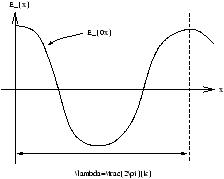
Figure 3.1 - ???
also
H=H0cos(kx-w t-f)
Þ H0=H0xx+H0yy+H0zz (3.9)
where f is the phase relation of H to E .
-
E0x and H0x :
- longitudinal components
- E0y and H0y :
- transverse components
- E0z and H0z :
- transverse components
3.2.1 Longitudinal Nature
we now show that E and H satisfy the wave equation. To do this we substitute the electric field into the wave equation (only x-axis propagation so there are no y or z components)
Ñ2E=-k2E
and substituting in the wave equation we obtain
so
w2=k2c2 (3.10)
this is the condition for the wave to satisfy Maxwell's Equations. This is also the same result you get with the magnetic field.
Phase fronts propagate at the speed of light.
3.2.2 Transverse Nature
The electric and magnetic fields must obey
Ñ .H=0, Ñ .E=0
therefore
however as there is no motion in the y or z component we get
Þ -kE0xsin(kx-w t)=0
and for a none trivial solution we get that
E0x=0 (3.11)
the same is true for the magnetic field
H0x=0 (3.12)
these solutions show us that there are no electric or magnetic fields in the direction of propagation.
This allows us to conclude that the waves are transverse.
3.2.3 Phase
H=H0cos(kx-w t-f )
E=E0cos(kx-w t)
consider that
E(x,t)=E0cos(kx-w t)y
we use Faraday's Law to obtain H
we integrate with respect to time
| H(x,t)= |
|
cos(kx-w t)z+constant |
There is no connection between Ey , Ez , etc. So Ey and Ez can be of arbitrary phase in respect to one another. This is usually the case (see section 3.5).
3.2.4 Orthogonal
E and H are orthogonal
3.2.5 Direction of Energy Flow
N=E×H=Ey+Hz
y×z=x
N=Nx
The energy flow is in the direction of propagation.
3.2.6 The Ratio of The Electric and Magnetic Field
this is because w/k=c . The ratio of the fields are a constant. This constant is the wave impedance in a vacuum.
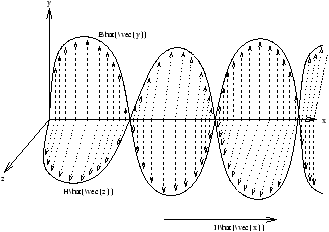
Figure 3.2 - The Structure of an Electromagnetic Wave
3.3 Radiation Pressure
3.3.1 Momentum in an Electromagnetic Wave
We have p (momentum)= k . A Photon has E (energy)=w and w/k=c and so we get
The momentum density is equal to np where n is the number of particles per unit volume. This easily becomes nE/c . We can also so that the energy density ( U ) is nE ( U defined in handout 4).
also we have
<N>=c<U>
and so
When radiation is incident on a surface it is either absorbed or reflected and so a pressure is exerted.
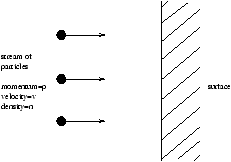
Figure 3.3 - Radiation Pressure
the flux of particles hitting the surface is nv (particles m-2s-1 ).
The momentum per particle which is given to the surface is
-
p when absorbed
- 2p when reflected
the pressure is the force per unit area and so is flux multiplied by the change of momentum.
| ?? |
absorb |
reflect |
| pressure |
nvp |
2nvp |
| EM pressure |
ncp |
2ncp |
| pressure |
<N>/c |
2<N>/c |
| pressure |
<U> |
2<U> |
| |
where
-
comets (Problem Sheet 3):
-
- solar sail:
- to go out in the solar system system
outward force (radial pressure)=radial pressure A
where the outward force is more than the inward gravitational force and A is the area of the sail
3.4 Wave Polarisation
Example:
Ey=Ey0cos(kx-w t)
Ez=Ez0cos(kx-w t-f)
what we want to know is how the electric field behaves with time
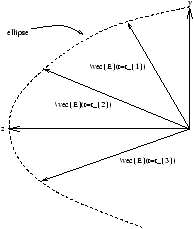
Figure 3.4 - ???
The electric field traces out a line in the y-z plane
-
linear polarisation:
- we set f=0 and that Ey and Ez are in phase
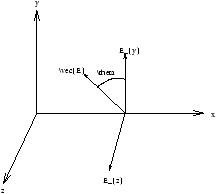
Figure 3.5 - Linear Polarisation (y-z plane)
we find that q is either a positive or negative constant
- circular polarisation:
- if f =±p/2 and Ey0=Ez0
Ey=Ey0cos( kx-w t)
Ez= Ez0sin(kx-w t)
and so the electric field vector describes a circle.
- in general, electric traces an ellipse
-
3.5 Electromagnetic Waves in Three Dimensions
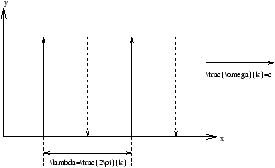
Figure 3.6 -
E(
x,
t)=
E0cos(
kx-
w t+
f )
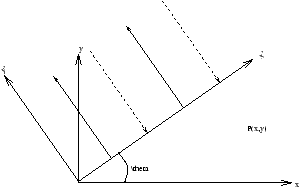
Figure 3.7 - Rotate by
q
so
E=E0cos(kx'-w t)
we relate x' to x and y
x'=xcosq+ysinq
so that
E=E0cos(kxcosq+kysinq-w t)
we define the wave vector ( k ) as
k=(kx,ky,0)=(kcosq,ksinq,0)
r=(x,y,z)
Þ E=E0cos(k.r-w t)
In three dimensions it is the same technique that is used
E=E0cos(k.r-w t)
E=E0cos(kxx+kyy+kzz-w t)
3.6 Electromagnetic Waves in Complex Notation
In general
E=E0cos(k.r-w t+f )
By using De Moivre's Theorem
where  is taking the real part of the contents of the brackets.
We now define a new quantity called the complex field vector.
where
The complex amplitude vector contains direction, amplitude and phase of the electric field. If we drop the prime so that
where E0 is a complex number which represents the complex amplitude vector.
The recovery of the physical fields is covered in Problem Sheet 4.
3.6.1 Wave Equation in Complex Notation
By using complex notation the calculus is removed and replaced with algebra.
-
¶/¶ t :
- ¶E/¶ t=-wE0e (k.r-w t)
we have just replaced ¶/¶ t by -w .
- Ñ . :
- Ñ .E=¶ Ex/¶ x+¶ Ey/¶ y+¶ Ez/¶ z
| Ñ .E= |
|
æ
è |
E0xe |
|
ö
ø |
+ |
|
(E0x... )+ |
|
(E0z... ) |
| Ñ .E |
= kxE0xe |
|
+ kyE0ye |
|
+ kzE0ze |
|
Ñ .E=k.E
so we simply exchange Ñ . with k.
- Ñ× :
- Ñ×E=k×E
so we simply exchange Ñ× with k×
- Ñ2 :
- Ñ2E=k.kE
Ñ2E=-k2E
so we simply exchange Ñ2 with -k2
3.6.2 Maxwell's Equation
so in light of the previous subsection we now can rewrite some equations
-
Gauss:
- Ñ.E=0
Þ k.E=0
- No Monopoles:
- ie. transverse waves
Ñ .B=0
Þ k.B=0
- Faraday:
- Ñ×E=-µ0¶H/¶ t
Þ k×E=wµ0H
so
- Ampere-Maxwell:
- Ñ×H=e0¶E/¶ t
Þ k×H=-we0E
so
- Substitute Ampere-Maxwell into Faraday:
-
however as the waves are transverse the second term is zero and our solution becomes
w2=k2c2
this is the equation of an Electromagnetic Wave