Previous Contents Next

Chapter 2   EM Energy

Electromagnetic fields contain energy, for example

2.1   Forms of Electromagnetic Energy

2.1.1   Electric Field

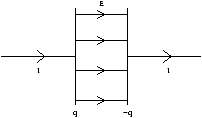
in a capacitor of capacitance C at a voltage V

Figure 2.1 - A Capacitor ( Q=CV )
electrostatic energy= ó
õ
VdQ=
1
2
CV2     (2.1)
C=
pe0R2
d
  (Problem Sheet One)
in terms of the electric field
1
2
CV2=
e0E2
2
× (volume)
so the electrostatic energy density is
UE=
e0E2
2
 Jm-3     (2.2)
As a general result
UE=
D.E
2
    (2.3)

2.1.2   Magnetic Field

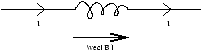
for example a solenoid

Figure 2.2 - A Solenoid
the magnetic energy is
magnetic energy=- ó
õ
VIdt= ó
õ
d
dt
(LI)Idt=
1
2
LI2
where L is the self inductance.
1
2
LI2=
B2
0
× (volume)
so the magnetic energy density is
UM=
B2
0
 Jm-3     (2.4)
or more generally
UM=
B.H
2
    (2.5)

2.2   Poynting's Theorem and FLow of Electromagnetic Energy

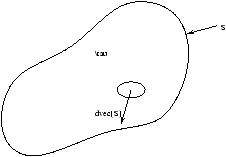
Consider a volume t boundary by closed surface S containing W Joules of stored energy.

Figure 2.3 - ???
The electromagnetic energy in the volume t can:
  1. be converted to other forms of energy (eg. heat)
  2. flow through to the surface
Formally
-
W
t
= ó
õ
Rdt +


S
N.dS     (2.6)
where
W= ó
õ


t
æ
ç
ç
è
B.H
2
+
D.E
2
ö
÷
÷
ø
dt     (2.7)
also W/ t is the rate of change of stored energy and R is the rate of change of stored energy into other forms of energy per unit volume ( m-3 ). N is the energy flux in the electomagnetic field through the surface S . The units for these quantities are W is in Joules, R is in Jm-3s-1 and N is in Jm-2s-1 .

Now we solve equation 2.6 for N
find R :
the electromagnetic field loses energy by accelerating particles
F=q(E+v×B)
the rate of doing work on a charge q is F.v
F.V=qv.E+qv(v×B)
so
ó
õ


t
Rdt = ó
õ


t
rfE.vdt
where rf is the number of charges and F.v is the work done per charge. Now
rfv=jf  (conduction current density)
ó
õ


t
Rdt = ó
õ


t
jf.Edt     (2.8)
find N :
N.dS=-
t
ó
õ
æ
ç
ç
è
E.D
2
+
B.H
2
ö
÷
÷
ø
dt - ó
õ
jf.E
we assume that the following two equations are Homogeneous, Isotropic and Linear
D=eE
BH
we substitute and differentiate
N.dS =- ó
õ


t
æ
ç
ç
è
eE.
E
t
+
1
µ
B.
B
t
ö
÷
÷
ø
dt- ó
õ
j
fdt =- ó
õ


t
æ
ç
ç
è
E. é
ê
ê
ë
jf.
D
t
ù
ú
ú
û
+H.
B
t
ö
÷
÷
ø
dt
where jf.D/t=Ñ×H and B/t=-Ñ×E so now we can obtain
... =- ó
õ


t
(E.Ñ×H-H.Ñ×E)dt
now using vector identities
Ñ.(F×G)=G.(Ñ×F)-F.(Ñ×G)
so
N.dS = ó
õ


t
Ñ.(E×H)dt
we use the divergence theorem
B.dS =


S
(E×H).dS
so
N=E×H     (2.9)
where N is known as the Poynting vector. The differential form of this can be obtained by starting with the integral form from equation 2.6 and to use Gauss' Theorem


S
N.dS = ó
õ


t
Ñ .Ndt
we now get
W
t
+ ó
õ


t
jf.E .dt + ó
õ


t
Ñ .Ndt =0     (2.10)
where the volume is arbitrary. We can go on to get
t
æ
ç
ç
è
E.D
2
+
B.H
2
ö
÷
÷
ø
+Ñ .N+jf.E=0     (2.11)

2.3   Example - Energy Flow



The flow of energy from a capacitor to a resistor. The resistor we will assume is a cylinder of length l and surface area A (radius r ), with a potential difference applied V across the ends.

Figure 2.4 - Energy Flow From a Capacitor to a Resistor

In figure 2.4 we will find that the energy doesn't flow through the wires it actually flows through the space between the wires via the magnetic field.

The power dissipated by the resistor is
ó
õ
jf.Edt
jf=
I
A
,  E=
V
l
, t =Al
the power is
P=
I
A
.
V
l
.Al=IV

Figure 2.5 - Poynting Flux

Figure 2.6 - Side on View of Poynting Flux
H=
I
2p r
q
N=E×H=
I
2p r
E
this Poynting Flux is towards the resistor. The power into the resistor is


S
N.dS=
I
2p r
E.2p rl
E.l=V
ó
õ
N.dS=VI
This shows that the energy is conserved however it flows in the space and not the wires.

2.4   Other Examples


Previous Contents Next