

Chapter 1 Maxwell's Equations
1.1 Electric Charge
some facts about electric charge
-
positive and negative charges exists. Their value's match to at least one part in 1020 . The smallest amount of (stable) charge you can have is 1.6022× 10⁻¹⁹ C
- charge is conserved
- charge is invarient under Lorentz Transformation
- the force between two charges obeys Coulomb's law

Figure 1.1 - Force Between Two Charges
where e0=8.85× 10⁻¹² Fm-1 and r=r/|r| which is the unit vector of r .
- comparing the Coulomb force between two electrons with the gravitational force setup between them
the ratio of the two forces
although this is a very small value gravity still matters as on large scales the number of positive and negative charges are more or less equal.
- moving charges produce another force, the magnetic force
1.2 Magnetism
The force on a charge q due to a magnetic field is
F=q(v×B)
1.3 Vector and Vector Fields
see the handouts
1.4 Revision of Maxwell's Equations
We describe emlectromagnetic fields in terms of field vectors:
-
E is the electric field vector and its units are in volts per metre
- B is the magnetic field vector and measured in tesla's
- r is the total charge density and is measured in coulombs per m3
- the total current density ( j ) is measured in amp's per m2
Þ F=q(E+v×B)
1.4.1 Electric Field
Electric fields are produced by
-
charges (coulomb's law):
- the electric field of a stationary charge q at a distance r is
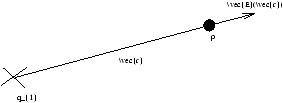
Figure 1.2 - Coulomb's Law for a Point Charge
however this only for a point charge, for a non-point charge we need to integrate equation 1.1 over a surface S which is enclosing the charge
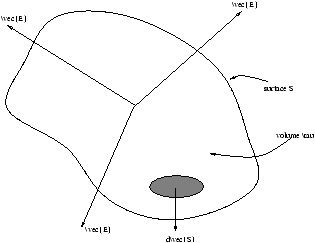
Figure 1.3 - Coulomb's Law for a Non-Point Charge
for a spherical surface (which is then true for any surface)
for many charges within the surface S
where qi is the ith charge. For a distributed charge density r(r)
this is Gauss' Law. If we use divergence theorem we obtain
so
this is Maxwell's First Equation
- electromagnetic induction:
- we define the electromotive force
where C is the line integral around the circle l
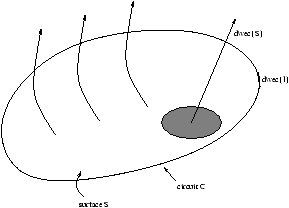
Figure 1.4 - Magnetic Induction
we now assume there is a magnetic field through the circuit and so we define flux ( F ) associated with B as
Faraday's Law is
Stokes :aw gives use
1.4.2 Magnetic Field
Magnetic fields can be produced by moving charge currents and displacement currents.
-
no magnetic charges:
- it can be shown from Bio-Savart that
Ñ .B=0 (1.6)
which is Maxwell's Third Equation. By using the divergence theorem we obtain
- magnetic field's due to currents:
-
-
steady current:
- the Biot-Savart Law (1820) says
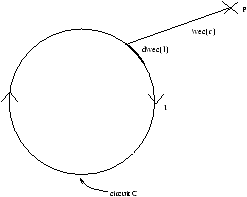
Figure 1.5 - Steady Current
the magnetic field at P a distance r from a circuit is
where µ0=4p× 10-7 Hm-1 and is called the permability of free space
- generalise:
- we consider the current density j Am-1 in a volume t
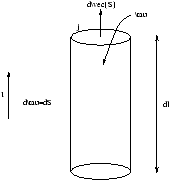
Figure 1.6 - Generalising the Biot-Savart Law
then
Idl=jdSdlj=jdt
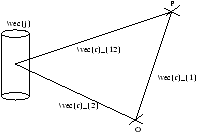
Figure 1.7 - ???
we take the curl of equation 1.9 and obtain the Bio-Savart Law
Ñ×B=µ0j (1.9)
or
this is the steady current law (Ampere's Law). However this is incomplete. So by taking the divergence of equation 1.10
Ñ .(Ñ×B)=0µ0Ñ .j
we require that there is charge gain or loss from the body
and integral form
- displacement current:
- we use equation 1.1 to write
r =e0Ñ .E
and this is substituted into equation 1.11
If the j in the Maxwell Equation (equation 1.10) with
we obtain
this is Maxwell's Forth Equation, or it can be written as
1.4.3 Internal Consistency
If we take the divergence of Faraday's Law we get
therefore we can conclude
Ñ .B=0
and we see we have not gained any extra information, these equations are the same (consistent).
If we take the divergence of Ampere's Law (Maxwell's) equation we obatin
| |
[ |
Ñ .(Ñ×B)=0 |
] |
= |
é
ê
ê
ë |
Ñ .j+e0 |
|
(Ñ .E)=0 |
ù
ú
ú
û |
1.4.4 Force of Particle
Newton's equation gives
where v is the velocity of the particle.
If we now v.(equation 1.14) we get
since v.(v.B)=0 and v2=v.v . So we can deduce that this is only changed by the electric field.
1.5 Materials in Electromagnetic Theory
Generally in Electromagnetic Theory there are three kinds of materials that are modeled
-
conductors:
- are an assembly of microscopic charged particles which are free to move about. For example conduction bands with electrons and also Ions are proportional to electrons in a plasma.

Figure 1.8 - A Conductor
we make the following definitions
-
free charge density ( rf ):
- this is the charge density in the conductor
- conduction current density ( jf ):
- is the density of the current in a conductor
- dielectrics:
- are an assembly of microscopic electic dipoles. For example the number of equal charges is proportional to the number of opposite charges where q is separated by a distance l
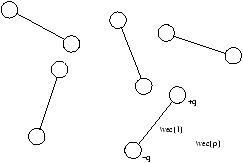
Figure 1.9 - A Dielectric
we make the following definitions
-
the dipole moment ( p ):
- p=ql Cm
- electric polarisations ( P ):
- P=åtp/t Cm-2
This is a macroscopic quantity where t is the volume. P is a flux of charge out of the volume t
- polarisation charge density ( rP ):
- by considering a volume t bounded by a surface S
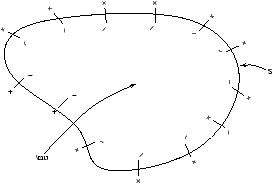
Figure 1.10 - Polarisation Charge Density
if we consider all the dipoles to be pointing outwards and so the volume is negatively charged we can calculate rP Cm-3 . To relate rP to vecP , the net charge due to polarisation is
dQP=-P.dS
if this is integrated
and then by using the divergence theorem
also
this can be equated to obtain
rP=-Ñ .P
- polarisation current density ( jP ):
- states that charge is to be conserved
we have rP=-Ñ .P which we can substitute to obtain
so we finish of with the current being
and the charge to be
r =rf-Ñ .P+0
where
- magnetic:
- are an assembly of microscopic magnetic dipoles formde from current loops.
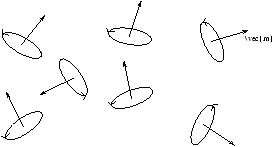
Figure 1.11 - Magnetic Materials
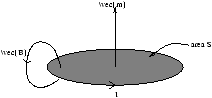
Figure 1.12 - A Current Loop
we define
-
dipole moment:
- m=IS Am2
- magnetisation:
- M=åtm/t Am-1
- magnetic charge density:
- is zero
- magnetisation current density ( jm ):
- is the current density associated with the current loops
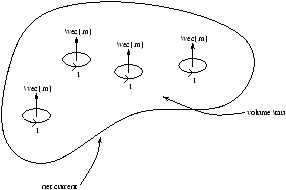
Figure 1.13 - Dipoles Summing to a Current
we recall that Ñ .B=µ0j for the total j so we can define
jm=Ñ×M (1.15)
The proof is tedious and so overlooked (see First Year EM Notes for Dr. Coppin's Lectures)
so we finish of with the current being
and the charge to be
r =rf-Ñ .P+0 (1.17)
where the current and charge are of the form (conduction)+(dielectic)+(magnetic)
1.6 Forms of Maxwell's Equations
1.6.1 Second Universally Valid Form of Maxwell's Equations
-
Gauss' Law:
-
or
Ñ .(e0E+P)=rf
we define the electric displacement
D=e0E+P
so we can rewrite Gauss' Law as
Ñ .D=rf (1.18)
- Amperes-Maxwell Equation:
-
| Ñ×B=µ0 |
é
ê
ê
ë |
jf+ |
|
+Ñ×M |
ù
ú
ú
û |
+µ0e0 |
|
1.6.2 Maxwell's Equations in a Homogeneous Isotropic and Linear Medium (A HIL Medium)
the definitions of the following are
-
homogeneous (H):
- means the same at all points in space
- isotropic (I):
- means it responds the same in every direction
- linear (L):
- PµE and MµH
P=e0ceE
where ce is the electric susceptibility
M=cmH
where cm is the magnetic susceptibility, so
D=e0E+e0ceE=e0(1+ce)E=e0-erE
or
D=eE
this is also same for the magnetic field
B=µ0(1+cm)H=µ0µrH
or
B=µH
where e is the permitivity of the medium and µ is the permeability of the medium.
So Maxwell's Equations are
Ñ .H=0
1.7 Vector and Scaler Potentials
1.7.1 The Scaler Potential (Feymann, Chapter 6)
For a stationary magnetic field
Ñ×E=0
now since Ñ×Ñ V=0 we can write
E=-Ñ V (1.20)
where V is the scaler potential in the units of Volts.
1.7.2 The Vector Potential (Feymann, Chapter 14, 15 and 18)
We have that
Ñ .B=0
however since Ñ .(Ñ×A)=0 we get
B=Ñ×A (1.21)
where A is the vector potential in the units of Tesla Metres.
From Faraday's Law
or
so when we integrate this we obtain (the curl just disappears)
where ¶A/¶ t is the inductive part of the equation and Ñ V is the stationary charges part.
1.7.3 Generation of Electromagnetic Radiation
THIS SUBSECTION IS NOT EXAMINABLE
assume
the speed of light is
c2=(µ0e0)-1
to we obtain
if we know j and r then we can obtain A and V and hence deduce E and B . This describes the eneration of electromagnetic waves due to the acceleration of charges.
1.8 Electromagnetic and Special Relativity
THIS SECTION IS NOT EXAMINABLE
1.8.1 The Lorentz Transformation of Electromagnetic Fields
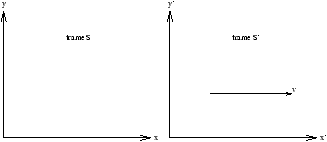
Figure 1.14 - The Lorentz Transformations
Ex'=Ex
Ey'=g (Ey-vBz)
Ez'=g (Ez+vBy)
Bx'=Bx
where
so for example motion in a static magnetic field
-
in frame S:
- E=0 and V=By
- in frame S':
- Ez'=g vB and By'=g By
1.8.2 Four Vectors (Feymann, Chapter 25)
where quantities are invarient under the Lorentz Transformations.
Equations 1.25 and 1.26 are
2A=µ0j
is this is the D'Alembertion invarient.
we write this as
so this shows that Maxwell's equations remain invarient (are unchanged) by the Lorentz Transformation.