More about state variables, P , V , T and N are state variables, heat and work are not!
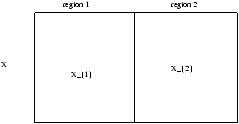
Figure 1.1 - System at Equilibrium
Information about a system in equilibrium:
Extensive (proportion to amount (at fixed values of the intensive quantities)):
V=V1+V2
N=N1+N2
Intensive (independent of amount):
T=T1=T2
P=P1=P2
if X and Y are extensive then X/Y is intensive. eg. N/V is an intensive quantity as both are proportional to N and so the N cancels out.
if X is extensive and Y is intensive, then XY ?
X=X1+X2, Y=Y1=Y2
XY=(X1+X2)Y=X1Y1+X2Y2=(XY)1+(XY)2
so XY is extensive. eg. PV .
1.2 Zeroth Law of Thermodynamics
1.3 Kinetic Theory

Different types of motion (degrees of freedom):
Figure 1.2 - Translational Motion
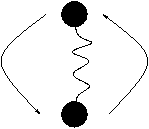
Figure 1.3 - Rotational (diatomic)
Two degrees of freedom
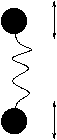
Figure 1.4 - Vibrational (diatomic)
Two degrees of freedom
Different degrees of freedom are not necessarily all active (except at very high temperatures).
1.4 Van der Waal's (equation of state)
PV=NkT
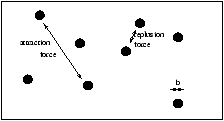
the above equation is good for low pressures and high temperatures however it breaksdown outside of these conditions due to intermolecular forces. More generally short range causes repulsion whilst long ranges cause attraction.
Figure 1.5 - Molecules In a Box, therefore Attraction/Repulsion
Short Range Repulsion:
each molecule occupies a volume b , effectively
V ® V-Nb
P(V-Nb)=NkT
Long Range Attraction:
reduction in pressure on walls
P=
NkT
(V-Nb)
-¶ P
¶ Pµ
N
V
×
(N-1)
V
~
N2
V2
this is because N/V is the value of particles hitting wall and for (N-1)/V is the value of particles attracted to the particle at wall.
So combining these results. Let
¶ P=a
N2
V2
therefore
æ ç ç è
P+
aN2
V2
ö ÷ ÷ ø
(V-Nb)=NkT (1.1)
a and b are constants, independent of N . Equation 1.6 reduces to PV=NkT for low pressures.
Originally (1873) empirically derived relation for real gases. This equation can also describe liquids (at least qualitatively).