

Chapter 27 Lecture 26 - Systems With Several Particles
27.1 Multiple Particle Wavefunctions
For a single particle we can define a wavefunction Y (r) which when manipulated to |Y (r)|2 which can be interpreted as a probility density.
For a N-particle system the wavefunction becomes
Y (r1,r2,... ,rN) (27.1)
so that |Y (r1,r2,... ,rN)|2 can be interpreted as a joint probability, ie the probability that a particle one is at position r1 , that particle two is at position r2 , etc.
The N-particle Schrödinger equation
HY (r1,r2,... ,rN)=EY (r1,r2,... ,rN) (27.2)
H is an N-particle Hamiltonian composed of
-
N kinetic energy operators, ie -2/2m1Ñ12 , ...
- N single particle potentials, ie V1(r1) , ...
- interaction potentials between pairs of particles
V1,2(r1,r2), ... ,V1,N(r1,rN)
27.2 Non-Interacting Particles
In this case if there is no interaction then we obtain a simplifed version of the Hamiltonian
|
H |
= |
|
æ
ç
ç
è |
- |
|
Ñk2+Vk(rk) |
ö
÷
÷
ø |
(27.3) |
Y (r1,r2,... ,rN)=U(1)(r1)U(2)(r2),... ,U(N)(rN) (27.4)
where U(k) is the state of the k'th particle and rk is the position coordinate of the k'th particle.
In this case
|
HY (r1,r2,... ,rN)= |
æ
ç
ç
è |
|
E(k) |
ö
÷
÷
ø |
Y (r1,r2,... ,rN) (27.5) |
-
often we can ignore particle interactions
- if there is an interaction, eg.
then with equations V.64 and V.65 we obtain zero order solutions
27.3 Identical Particles
The could be for example pairs of electrons, protons, neutrons or a particles. When in the same energy and spin states such that they are fundementally indistinguishable.
To investigate this we will consider a generic elastic scattering experiment between two particles, which we will label 1 and 2 (but these may be identical). We will be working the the centre of mass frame

Figure 26.1 - The Centre of Mass Frame
f1(q ) is the scattering probability amplitude for the particle i to be scattered into the angle q .
We place the detectors DI and DII at locations q and (p -q )
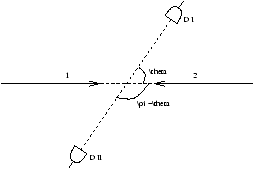
Figure 26.2 - The Scattering Experiment
There are two ways to register hits simultanously at DI and DII
-
case A:
- forward scattering
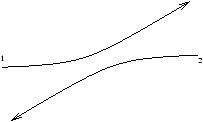
Figure 26.3 - Forward Scattering Result
probability detection 1 at DIµ |fA,1(q )|2 probability detection 2 at DIIµ |fA,2(p -q )|2 (27.6)
by conservation of momentum
|fA,2(p -q )|2=|fA,1(q )|2
- case B:
- backward scattering
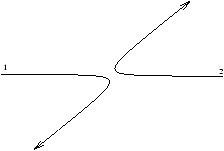
Figure 26.4 - Backward Scattering Result
probability detection 1 at DIIµ |fB,1(p -q )|2 probability detection 2 at DIµ |fB,2(q )|2 (27.7)
by conservation of momentum
|fB,1(p -q )|2=|fB,2(q )|2
Now since both case A and B can occur how do the probabilities of these events combine? What is the total probability of the detector DI seeing particles?
If q =p/2 we should find by symmetry
|
|
½
½
½
½ |
fA,1 |
æ
ç
ç
è |
|
ö
÷
÷
ø |
½
½
½
½ |
|
= |
½
½
½
½ |
fB,2 |
æ
ç
ç
è |
|
ö
÷
÷
ø |
½
½
½
½ |
|
= |
½
½
½
½ |
f |
æ
ç
ç
è |
|
ö
÷
÷
ø |
½
½
½
½ |
|
(27.8) |
| spin |
particle 1 |
particle 2 |
q=p/2 |
q |
| 0 |
a |
p |
2|f(p/2) |2 |
|fA(q )|2+|fB(p -q )|2 |
| 0 |
a |
a |
4|f(p/2) |2 |
|fA(q )+fB(p -q )|2 |
| 1/2 |
p |
p¯ |
2|f(p/2) |2 |
|fA(q )|2+|fB(p -q )|2 |
| 1/2 |
p |
p |
0 |
|fA(q )-fB(p -q )|2 |
| |
so for non-identical particles we add the probabilities however for identical particles we add the amplitudes.
There are two types of particles, ones with spin 0 - where we get constructive interference (bosons) and half spin where we get destructive interference (fermions).