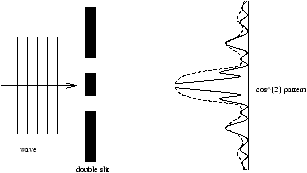
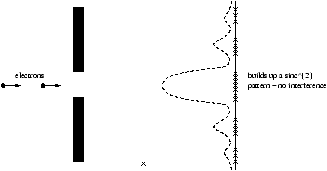
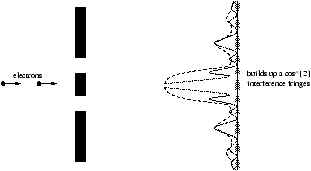
but only one particle is in the apparatus (in figure 3.3) at any one time - how does the intereference occur?

there exists two equivalent paths or amplitudes. ie. the particle goes via slit A or the particle goes via slit B.
Figure 3.4 - Possible Paths of Particle
this is an essential condition for interference
the state of each particle is a superposition of amplitude A and amplitude B thus constructive or destructive interference occurs depending on the relative magnitudes and signs of amplitudes A and B for a given angle q . Any attempt to detect which slit the particle is passing through destroys this superposition and no interference pattern is seen.
The superposition survives provided there is indeterminacy (the amplitudes are indistinguishable)
3.2 Non-Classical Physics
3.2.1 Uncertainity Relations
There is a constraining uncertainity in simultaneous measurements of some observables (eg. position, momentum and energy).
D xD p
2
(3.1)
equation I.17 limits the usefulness of the classical concept of a trajectory if microscopic particles are considered.
Other observables are not constrained. eg. x and y position can be simultaneously measured to an arbitrary precision
D xD y 0
Any attempt to measure accurately D x or D px results in the loss of information about the other quantity. Thus measurements of x and px are incompatible.
3.2.2 Wave Functions
The probability of a position measurement finding a particle at x is given by the modulus squared of the probability amplitude ( f(x) ).
P(x)=|f(x)|2 (3.2)
f(x) is called the wave function of the particle.
3.2.3 Superpositions
When an event can occur in several alternative ways (eg. a single particle passing through a double slit experiment) then the probabilty for the event is the sum of all the alternative probability amplitudes ( fn )
f =f1+f2 (3.3)
the probability of the event is the modules squared of this sum
P=|f1+f2|2 (3.4)
thus there can be interference in the probability.
An Example - Two Slit Experiment
at some angle q , the amplitude through slit is fA(q ) and the amplitude through slit B is fB(q ) then
P(q )=|fA(q )+fB(q )|2
if fA(q )=fB(q ) you get constructive interference.
if fA(q )=-fB(q ) you get destructive interference.