ie. light behaved like a electromagnetic wave in the early part of the 19th century. However when examined at low intensity it behaves more like a particle.
Matter also exibitics both a wave and particle nature.
1.1 The Photoelectric Effect (waves behaving like particles)
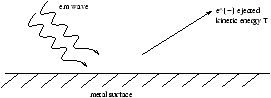
Figure 1.1 - Millikan's Experiment
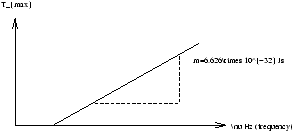
Figure 1.2 - Graphing the Photoelectric Effect
Tmax=hn-f (1.1)
f is the work function of the metal
Einstein postulated (1905) that EM radiation of frequency n can behave as if it consists of discrete units (quanta) with energy hn .
Light behaves like a quanta but also like a wave
diffraction
interference
Photon Properties:
E=hn (1.2)
from Compton Scattering
p=
h
l
(1.3)
Wave Properties:
F (the electric field amplitude) obeys a wave equation. So in free space
¶2F
¶ t2
=c2
¶2F
¶ x2
(1.4)
this has a sinusoidal solution
F=F0sin(kx-w t) (1.5)
k=2p/l wave vector, w =2pn angular frequency
using the definition that
=
h
2p
and equations I.2 and I.3 we obtain
k=
p
w =
E
(1.6)
1.2 Electron Diffraction (particles behaving like waves)
an experiment in 1927-28 Davissan and Germer (USA) and also G.P. Thomson (IC) discovered this effect.
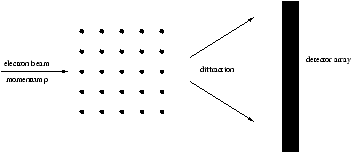
Figure 1.3 - Electron Diffraction Experiment
Diffraction pattern was identical to X-rays therefore since electrons give diffraction, electrons behave like waves. They found that l=h/p .
de Broglie postulated that electrons have wave like properties.