Contents Next

Chapter 1   One Electron Systems (Gross Structure)

Most atoms have many electrons. About ten lectures will be spent on one electron atoms. This is because:
  1. they are exactly solvable
  2. the theory is important in the historical development of Quantum Mechanics (QED)
  3. the solar system analogy, the greatest force on a planet is towards the centre (our sun) where they act nearly as independent particles. This can be used to build up a solar system by solving many two body problems. Later this is how we will treat the more complicated atoms however at first we need to solve the two body problem in detail.
The simplest atom is hydrogen which is made up of a single proton ( p+ ) and a single electron ( e- ). The advantage of basing our work around the hydrogen atom is that it can be applied to other two body systems such as
hydrogen like atoms:
the nucleus has a greater charge ( Ze ) and a greater mass than for hydrogen. Examples of this are
4He+º (2p++2n)+1e-
7Li2+º (3p++4n)+1e-
the lithium example is known as doubly ionised lithium
238U91+º (92p++146n)+1e-
hydrogen like ions can exist naturally (such as in astro physics) or can be created in a lab
muonic hydrogen:
we take a proton and allow it to capture a muon (for example near a nuclear generator) which forms muonic hydrogen. However muons are heavy, Mµ~ 207Me
p+-
positronium:
where a atom is formed with an electron and a positron ( Me+=Me- )
e++e-
anti-hydrogen:
anti-protons are used with positrons to form anti-hydrogen atoms
p-+e+
where Mp-=Mp+

1.1   Hydrogen Spectrum

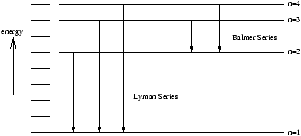
Figure 2.1 - Line Spectrum (See Figure 2.1 on the Handout)
The general features of the Figure 2.1 are Balmer (1885) showed that all the hydrogen lines fit a simple formula
1
l
=R æ
ç
ç
è
1
n12
-
1
n22
ö
÷
÷
ø
    (1.1)
for when n1=1 we obtain the Lyman series where n2 is an integer which is more than n1 . If n1=2 we obtain the Balmer series. If n1=3 then we get the Paschen series. In equation 2.1 R is known as the Rydberg Constant which equals 109677 cm-1 (see the later note on the units). This spectra fit is accurate to one part in 104 .

1.2   Bohr Model

In 1913 the atomic size was known to be approximately 1× 10⁻¹⁰ m (from experiments in gas kinetics and X-ray diffraction (1912)). The spectrum was well known to fit the Balmer formula which was derived completely by emperical techniques so there was no theoretical understanding behind it. This is what Bohr was about to find out, why! He built a theory on four postulates
  1. the electron moves in a circular orbit around the proton
  2. not all orbital radii are permited, only those whose angular momentum obeys (is quantised)
    L=n  (n=1,2,3,... )
  3. the orbits are stable despite the affect of accelerating an electron (charge) it does not radiate energy
  4. electromagnetic radiation is emitted where the electron makes a quantum jump to a smaller orbit
from the first postulate we can determine that
Þ
men2
r
=
e2
4pe0r0
    (1.2)
the second postulate gives us
Þ L=men r=n     (1.3)
by solving equation 2.2 and 2.3 for r and n we obtain
r=n2a0,  a0=
4pe02
mee2
    (1.4)
where the constant a0 is known as the Bohr Constant and is about 5.3× 10⁻¹¹ m . We also find that
n =
mna0
    (1.5)
The total energy is the kinetic part added to the potential
E=T+V=
1
2
mev2-
e2
4pe0r
now substituting for n and r into equations 2.4 and 2.5
E=-
R
 
¥
n2
hc,  R
 
¥
=
1
2
mee4
(4pe0)22
1
hc
The value of R¥ is 10973700 m-1 (or more commonly it is 109737 cm-1 ) which is very similar to the Rydberg constant.

A transistion from n1 to n2 gives us
D E=E
 
n2
-E
 
n1
=hcR
 
¥
æ
ç
ç
è
1
n12
-
1
n22
ö
÷
÷
ø
however
D E=hn =
hc
l
ie. this is Rydberg's fromula, the small discrepency between R and R¥ is removed by using the reduced mass (we understand that the infinity value R is for a nucleus of infinite mass).
me® m=
meme
me+me

Figure 2.2 - Energy Transistion Levels
for example when n1=1 and n2=2
1
l
=R æ
ç
ç
è
1
1
-
1
4
ö
÷
÷
ø
=
3
4
R

However there are some problems with the Bohr model

1.3   Hydrogen Schrödinger Equation

The starting point for a proper quantum mechanic treatment of hydrogen is to use the Schrödinger Equation for an electron in the coulomb potential of the nucleus.
é
ê
ê
ë
-
2
2m
Ñ2+V(r) ù
ú
ú
û
Y (r)=EY (r)     (1.6)
the mass in this equation is the reduced mass and the potential is
V(r)=V(r)=-
Ze2
4pe0r
    (1.7)
and
Ñ2=
1
r2
é
ê
ê
ë
r
æ
ç
ç
è
r2
r
ö
÷
÷
ø
+(q ,f ) ù
ú
ú
û
    (1.8)
where
(q ,f )=
1
sin2q
2
f2
+
1
sinq
q
æ
ç
ç
è
sinq
q
ö
÷
÷
ø
    (1.9)
our primary goal is to solve equation 2.6 for E . There are many functions of Yn(r) that may statisfy equation 2.6 so we expect to find many values for E1 and En .

To find En we must first find Yn(r) , however we can attempt to find a solution of equation 2.6 by seperation of variable (see Boas, page 544).

An trial solution
Y (r)=R(r)Y(q ,f )     (1.10)
we now substitute equation 2.10 into equation 2.6 (with equations 2.7, 2.8 and 2.9). We note that we now multiply through by -2mr2/2RY
1
R
d
dr
æ
ç
ç
è
r2
d
dr
R ö
÷
÷
ø
-
2mV(r)
2
r2+
2mE
2
r2=-
1
Y
(q ,f )Y     (1.11)
we note that there is no q or f on either the left or right hand side. So we can use seperation of variables to solve this equation. We notice that we wouldn't be able to do this if V(r) was of the form V(r,q ,f ) . This only works because the coulomb potential is centred.

We now introduce the seperation constant c1
1
R
d
dr
æ
ç
ç
è
r2
d
dr
R ö
÷
÷
ø
+
2mEr2
2
-
2mVr2
2
=c1     (1.12)
-
1
Y
(q ,f )Y=c1     (1.13)
the seperation of variables technique can again be used on equation 2.13. We use Y(q ,f )=Q (q )F (f ) and substitute this into equation 2.13. With (q , f ) which is given by equation 2.9, we multiply equation 2.13 by sin2q and then we introduce the seperation constant c2 .
-
1
F
d2F
df2
=c2     (1.14)
sinq
Q
d
dq
æ
ç
ç
è
sinq
dQ
dq
ö
÷
÷
ø
+c1sin2q=c2     (1.15)
we notice that F =ec2f is a solution of equation 2.14. We can now tell that c2º me so that c2=me2 .

Physically acceptable solutions must be single valued (ie. F (f )=F (f +2p ) ). A properly normalised solution is
F =
1
2p
e
mef
 
;  me=0,± integer     (1.16)
To solve equation 2.15 we write that e=cosq and use this to form F(e )=Q (q ) (this is the easiest method for this special case where me=0 .
d
de
é
ê
ê
ë
(1-e2)
dF
dE
ù
ú
ú
û
+c1F=0     (1.17)
this is the Legendre Equation. So we try a solution
F(e )=
¥
å
k=0
anek     (1.18)
we now substitute equation 2.18 into equation 2.17 and we obtain a recursion relation
ak+2= é
ê
ê
ë
k(k+1)-c1
(k+1)(k+2)
ù
ú
ú
û
ak     (1.19)
The polynomial F(e ) can be diverged at e=± 1 (ie. when q =0,p ,... ). The problem is removed if k does not tend to infinty and instead tends to some finite value, say l .

We require that al+2=0× al in equation 2.19. This occurs when l(l+1)=c1 . Now F(cosq)=åk=0lak(cosq)k . For the general case m¹ 0 solutions are associated Legendre polynomials (see appendix 1).

1.4   Solution

We substitute c1º l(l+1) into equation 2.12. We define a new function P(r)=rR(r) and multiply through by
-
2
2m
P
r2
    (1.20)
so we obtain
é
ê
ê
ë
-
2
2m
d2
dr2
+Veffective ù
ú
ú
û
P(r)=EP(r)     (1.21)
where
Veffective=-
Ze2
4pe0r
+
l(l+1)2
2mr2
    (1.22)
equation 2.22 is a one dimensional Schrödinger equation in co-ordinate r . However what is l(l+1)2/2mr2 physically?
clue one:
l(l+1)=c1 came from solving the angular equations
clue two:
classical mechanics of a particle in a central potential
Veffective=V+
l2
2mr2
where Veffective is the effective potential, V is the real potential (for example gravity) and l2/2mr2 is a ficticious potential arising from working in a non-inertial frame.
clue three:
l(l+1)2 has the dimensions (angular momentum)2

1.4.1   Qualitative Solutions

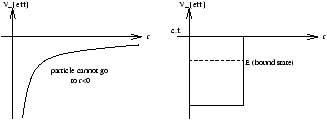
see on the handout (figure 2.3, HANDOUT) for the effective potential. We note that l=0 is a special case so that Veffective is qualitatively different frall all values where l¹ 0 . So we expect qualitatively different R(r) for l=0 . Because of this we will be treating the l=0 and the l¹ 0 case seperately.

Figure 2.3 - ???

Figure 2.4 - ???

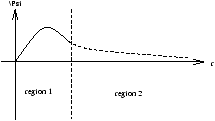
in region one Y~sin(kr) and in region two Y~ e-a r (see Gasiorowiez, page 185).

Near the origin

1.4.2   lneq 0 case


the l(l+1) term gives a gradual repulsive wall at a small value for r (see figure 2.4 on the HANDOUT)

Figure 2.5 - The l¹ 0 Case
This gives the form of P(r) in regions one, two and three.
region one:
P(r)~ rS , whatever S turns out to be. We still have P(0)=0 which is good since the region r<0 is forbidden
region two:
P(r) turns over smoothly (wiggles) so we can conclude that P(r)~ polynomial
region three:
P(r)~ e-a r

1.4.3   Quantitive Solutions

The cast radial (in simpler dimensionaless form) is
r=
r
a
where a is a constant in units of length. We use dr/dr=1/a and dr=adr so we multiply through by -2ma2/2 and let
l =
Ze2ma
2pe02
    (1.23)
a2=-
2
8mE
    (1.24)
é
ê
ê
ë
d
dr2
+
l
r
-
l(l+1)
r2
-
1
4
ù
ú
ú
û
P(r )=0     (1.25)
and now we need to seek solutions in regions one, two and three
region 3:
r®¥ , there are terms in 1/r and 1/r2 , this is small can can be compared with the term 1/4
é
ê
ê
ë
d2
dr2
-
1
4
ù
ú
ú
û
P=0     (1.26)
the solution can be P~ e-r/2 (like our guess)
region 1:
r® 0 , the term in 1/r2 is large when compared to the constant term and 1/r term
é
ê
ê
ë
d2
dr2
-
l(l+1)
r2
ù
ú
ú
û
    (1.27)
we recall that our guesses for P(r) is
P~r  l=0
P~rS  l¹ 0
using direct substitution so that S(S-1)=l(l+1) and so either S=l+1 or S=-l is irregular. Since l is positive, S=-l is physically unacceptable as it would give P®¥ as r® 0 . So for r® 0 we get P~ rl+1
region 2:
we suggest a polynomial, for example
g(r )=
¥
å
k=0
ckrk
we now propose a composite solution for all r
P~ e
-
r
2
 
rl+1g(r )     (1.28)
the substitution of equation 2.29 into 2.26 leads to an equation where the solutions are Laguerre polynomials (Baas, page 533 or B+J, page 132). These are acceptable solutions mathematically however the series diverges, so is not acceptable as a wavefuction physically. The condition that the wavefunction remains finite implies that the series must terminate at some value of k . This leads to the condition (quote result)
l =n     (1.29)
where n is a positive integer and greater than or equal to l+1 . See appendix one for the final wavefunction.

1.5   Significance of n, l and Ml

1.5.1   Quantum Number (n)

we solve equation 2.24, 2,30 and 2.25 for E and we obtain the Bohr Formula
E=-
Z2e4m
2(3pe0)22n2
where n is the principle quantum number.

1.5.2   Quantum Numbers l and Ml

classically l=r×p . In the Quantum Mechanics course you showed that
lz=-
f
l2=-2 é
ê
ê
ë
1
sinq
q
æ
ç
ç
è
sinq
f
ö
÷
÷
ø
+
1
sin2q
2
f2
ù
ú
ú
û
and that YlMl are simultaneous eigenfunctions of lz and l2 such that
l 2Y
 
lMl
=l(l+1)2Y
 
lMl
,  l=0,1,2,...
l zY
 
lMl
=Ml Y
 
lMl
,  Ml=l,l-1,l-2,... ,-l
where l is the orbital angular momentum quantum number and Ml is the magnetic quantum number.
Contents Next